A Glimpse Into Future Caribbean's Demo Weekend
A weekend celebrating Caribbean innovation, AI-powered problem-solving, and the people building solutions for the region's future.

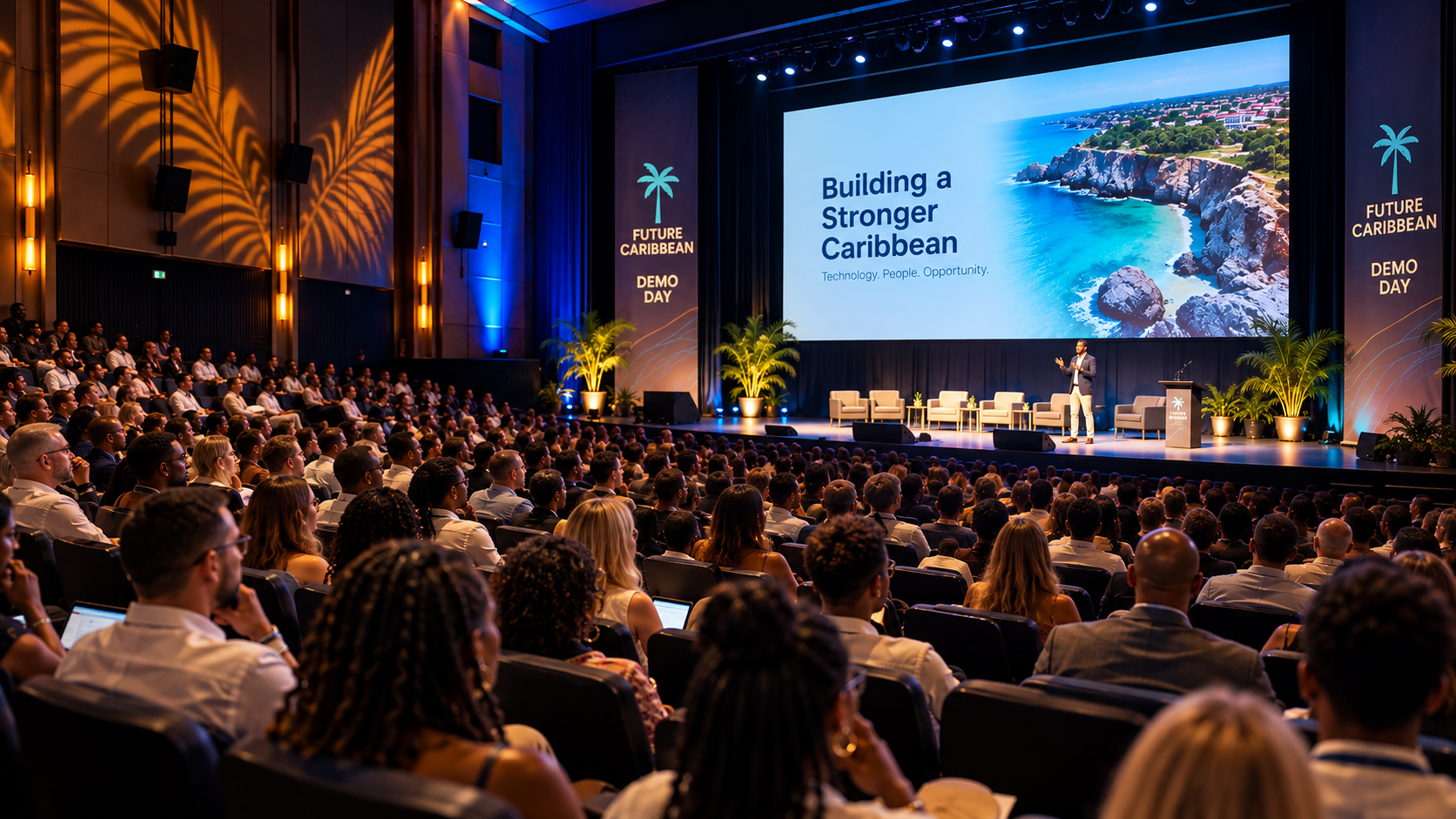
The Caribbean’s future will be shaped not only by the challenges we recognise, but by the people willing to build solutions to address them.
That spirit was at the heart of Future Caribbean’s Product Premiere and Demo Day weekend, which brought together builders, innovators, and technology enthusiasts to explore how artificial intelligence can help solve real-world problems across the region.
Over two days, the programme created space for ideas to move beyond conversation and into development. Friday’s Product Premiere offered an opportunity to celebrate innovation and introduce the weekend’s activities, while Saturday’s 12-hour Demo Day showcased the work of builders across the Buildathon’s ten tracks.
Together, the events reflected a growing movement to develop technology with Caribbean needs, communities, and opportunities in mind.
Friday: Celebrating the Possibilities of Caribbean Innovation
The weekend opened with the Product Premiere at Olympus Theatre in Barbados, setting the stage for a celebration of the ideas and ambition driving the region’s technology ecosystem.
The event highlighted the importance of creating an environment where Caribbean innovators can experiment, collaborate, and develop solutions with the potential to make a meaningful difference.
Artificial intelligence is rapidly changing how people work, access information, deliver services, and approach complex problems. Yet the opportunity for the Caribbean is not simply to adopt technologies developed elsewhere. It is also to participate in shaping how these technologies are used, adapted, and built to serve local realities.
That means understanding the region’s unique circumstances, recognising the opportunities within its communities and industries, and ensuring that innovation responds to challenges people actually experience.
The Product Premiere helped establish that wider context: Caribbean builders are not just watching the next wave of technological change unfold. They are contributing to it.
Saturday: Twelve Hours of Building, Testing, and Demonstrating
On Saturday, Future Caribbean hosted a 12-hour Demo Day, bringing together builders from across the Buildathon’s tracks to showcase their progress, share demonstrations, and present the problems they had been working to solve.
The extended programme offered a broad view of the different ways AI can be applied across industries and communities. Presentations explored everything from the realities of Caribbean energy grids and transportation networks to financial access, disaster response, regional trade, and creative expression.
Some builders demonstrated how AI agents could coordinate information and actions across complex systems. Others focused on helping people navigate services, making information more accessible, or supporting decisions that would otherwise require time-consuming manual work.
The projects differed in their approaches and stages of development, but a common ambition connected them: to make technology useful in practical, relevant, and locally meaningful ways.
Ten Tracks, One Shared Ambition
Across the ten tracks, builders explored challenges and opportunities that affect how Caribbean communities live, work, connect, and grow. The following themes reflect the ideas and discussions shared during the demonstrations.
The Electron Economy
Energy builders explored the challenge of transitioning Caribbean islands towards renewable energy while maintaining reliable electricity systems. Presentations examined how forecasting, solar and wind data, grid information, and AI-supported analysis could help energy professionals understand demand, anticipate changes in supply, and evaluate pathways towards regional renewable energy goals. The discussions highlighted the complexity of managing intermittent renewable sources within smaller island grids and the need to support informed decisions about energy infrastructure.
Tourism & Transportation
Presentations explored ways to make travel and transportation across the Caribbean more reliable, connected, and responsive. In transportation, builders discussed the realities of informal routes, inconsistent schedules, and the importance of local rider knowledge in helping people reach work, school, appointments, and other destinations. In tourism, ideas included coordinating travel arrangements when disruptions occur, helping visitors navigate their journeys, and reducing the burden on travellers and hospitality businesses when plans change. Across the track, the emphasis was on connecting information and services rather than treating each part of a journey in isolation.
Finance, Payments & MSME Capital
The financial services discussions addressed the fragmentation that can make it difficult for individuals and businesses to manage money, payments, and obligations across different markets. Builders presented approaches involving cross-border financial access, digital accounts, payment infrastructure, merchant services, reconciliation, and the processes that help financial transactions move between institutions. Other discussions explored how businesses could be better supported by financial systems and how AI agents might assist with complex workflows while retaining appropriate checks and human decision-making. A recurring theme was the importance of practical financial infrastructure that works across Caribbean markets.
Healthcare Systems & Delivery
Healthcare presentations focused on the challenges people face when navigating care and accessing timely support. Builders explored how technology could help organise information, support the delivery of services, and assist with processes such as triage and identifying appropriate next steps. The discussions reflected an interest in making healthcare experiences more manageable for people while helping providers use information more effectively. They also underscored the importance of designing systems around real needs and ensuring that technology supports, rather than replaces, appropriate human judgement.
Climate Risk & Disaster Coordination
Climate and disaster presentations explored the challenge of coordinating a response when information is scattered across reports, organisations, locations, and systems. Builders discussed how environmental observations, rainfall information, road conditions, shelter availability, and resource data could be brought together to support planning. Demonstrations considered how plans might need to change when a road becomes inaccessible or conditions shift, as well as how organisations could coordinate resources before, during, and after a disaster. A key theme was that disaster response is not only about predicting what might happen; it is also about helping people and organisations make informed decisions together, with human review remaining central to critical actions.
Ocean Systems & Blue Economy
The ocean-focused discussions reflected the importance of protecting the Caribbean’s natural environment while supporting the livelihoods and economic activities connected to it. Builders explored how technology and data could help strengthen environmental understanding, support the assessment of restoration and conservation efforts, and improve the information available to people working with natural resources. The presentations highlighted opportunities to connect environmental evidence with decision-making, helping the region think about both the protection of its ecosystems and the long-term potential of its blue economy.
Trade & Regional Commerce
Builders in this area explored challenges surrounding the movement of goods, the resilience of supply chains, and the coordination of regional commerce. Presentations considered how better access to information could help businesses understand changing conditions, identify relevant opportunities, and respond to disruptions. Food systems and agriculture also featured in the discussions, with ideas focused on helping connect production, distribution, and the wider systems that bring food to communities. Together, the work highlighted how technology could help reduce information gaps and strengthen the networks on which Caribbean commerce depends.
The Arts
The arts track created space to explore how AI might intersect with Caribbean creativity, culture, and artistic expression. The presentations reflected the potential for technology to support creative work, open up new ways of experimenting, and help artists explore different approaches to developing and sharing their ideas. At its heart, the track brought a different perspective to the Buildathon: innovation is not only about infrastructure and operational efficiency, but also about culture, imagination, and the ways people express themselves.
Real Estate & Development
Presentations in this track explored how technology could support decisions about property, development, and the built environment. Builders discussed opportunities to make information more useful for understanding properties and managing assets, as well as approaches to planning and resilience. The work reflected the potential for digital tools to help people make more informed decisions about the spaces and infrastructure that shape Caribbean communities.
Open Track
The Open Track brought together ideas that crossed traditional industry boundaries or followed a different direction altogether. Presentations explored a diverse range of challenges, including how organisations can use AI to work with information, coordinate tasks, and support more effective decision-making. Some approaches focused on specialised workflows, while others explored broader applications for research, communication, and the way people interact with digital systems. The variety of work reflected the purpose of the Open Track: to give builders room to pursue ambitious ideas that do not fit neatly into a single category.
Across all ten tracks, the presentations demonstrated the range of questions Caribbean builders are asking about the role of AI. How can systems work better together? How can people access the information they need? How can technology help organisations respond to changing circumstances? And how can solutions be designed around the realities of the region?
These were not one-size-fits-all answers. They were different approaches to different problems, brought together by a shared willingness to build and experiment.
More Than Technology: Understanding the Problems Behind the Products
A key takeaway from Demo Day was that building with AI involves much more than the technology itself.
Effective solutions begin with understanding the problem, the people experiencing it, and the context in which it occurs. They require thoughtful use of information, consideration of how people will interact with a product, and a willingness to test assumptions and improve what has been built.
Several presentations illustrated the importance of combining AI capabilities with reliable information, defined processes, and human oversight. Whether the challenge involved financial transactions, transportation information, or disaster response, the discussions showed that technology must be applied carefully and in the right place within a wider system.
AI can help automate tasks, organise information, and support decisions, but the value of any solution depends on how well it responds to a genuine need. Human judgement, responsible development, and an understanding of local realities remain essential.
The Buildathon created an environment for builders to explore these questions through experimentation. Demo Day offered an opportunity to share progress, communicate ideas, and make the development process visible to a wider audience.
The work presented was part of an ongoing journey: developing, testing, refining, and learning what it takes to turn an idea into something useful. That process matters just as much as the demonstration itself.
Building for the Caribbean, With the Caribbean in Mind
The weekend also highlighted the importance of creating opportunities for Caribbean builders to develop their skills and contribute to the region’s technological future.
Local context matters. The challenges faced by Caribbean communities, businesses, and institutions can differ from those in larger markets, and solutions must be designed with those realities in mind. Technology that is useful in the region should take into account the people it serves, the systems they rely on, and the circumstances in which it will be used.
The discussions throughout Demo Day made this especially clear. Caribbean transportation does not always follow the patterns assumed by global navigation platforms. Energy systems must account for the particular realities of small island grids. Regional businesses navigate financial and commercial processes across borders. Disaster response depends on coordination between people and organisations operating in changing conditions.
Understanding these realities is an important starting point for building relevant solutions.
This does not mean limiting the ambition of Caribbean innovation. It means building from a strong understanding of the region while creating work that can evolve, scale, and connect with opportunities beyond it.
Initiatives such as Future Caribbean’s Buildathon help create space for that process. They bring attention to the problems worth solving, encourage experimentation, and give builders an opportunity to share their thinking and progress with others.
They also help make innovation more tangible. Instead of discussing AI only in abstract terms, participants and audiences can engage with emerging ideas, consider their potential applications, and reflect on the next steps required to develop them further.
A Milestone, Not a Finish Line
Future Caribbean’s Product Premiere and Demo Day marked an important moment in the Buildathon journey, but the work does not end when the demonstrations are over.
The next stage of innovation involves continued testing, feedback, iteration, and learning. Some ideas will evolve in unexpected directions. Others will require further development before they are ready for wider use. Each stage offers an opportunity to better understand what works, what needs improvement, and where the greatest potential lies.
That is part of what makes a builder community valuable: progress is not measured only by finished products, but also by the knowledge, capabilities, and relationships developed along the way.
Over the course of the weekend, builders explored a wide range of challenges through the lens of AI and technology. Their work reflected the breadth of opportunity across the Caribbean and the importance of approaching innovation with curiosity, purpose, and a willingness to build.
The weekend was a celebration of what has been developed so far, as well as the energy and ambition needed to carry those ideas forward.
The Future Is Something We Build
The Product Premiere and 12-hour Demo Day were a celebration of more than emerging technology. They were a celebration of the people putting their ideas into action and contributing to a Caribbean innovation ecosystem that is still growing.
The weekend reinforced a simple but powerful idea: the region’s future should not be shaped solely by technologies created elsewhere. Caribbean communities can help define the problems, develop the solutions, and participate in determining how AI is used to support their own development.
There is still work ahead. Promising ideas need continued attention, prototypes need refinement, and meaningful solutions must be evaluated against the needs of the people they are intended to serve.
But every step forward contributes to a wider culture of building—one where local challenges inspire new approaches, collaboration strengthens ideas, and technology is treated as a tool for practical progress.
Through Future Caribbean, the Buildathon, and the wider community of people committed to creating, the region’s innovation story continues to take shape.
The future of Caribbean innovation is not just something to anticipate. It is something to build—together.
Inside Future Caribbean's 12-Hour Demo Day: The Projects Presented
Across ten tracks, Caribbean innovators explored how AI could respond to real challenges — from energy and transportation to finance, climate resilience, healthcare, and the creative economy.
From Carnival to Claude: The Caribbean’s Next Wave of Builders
Justin Elliott joined Future Caribbean to talk about Agentic AI. His most compelling message was about knowing a problem well enough to build something people need.