From Buildathon to Balance Sheet: Turning Caribbean AI Ideas Into Investable Ventures
A Future Caribbean fireside chat with David Doss on what happens after the prototype — defensible IP, realistic revenue math, deployable first products and why distribution now matters more than the build.

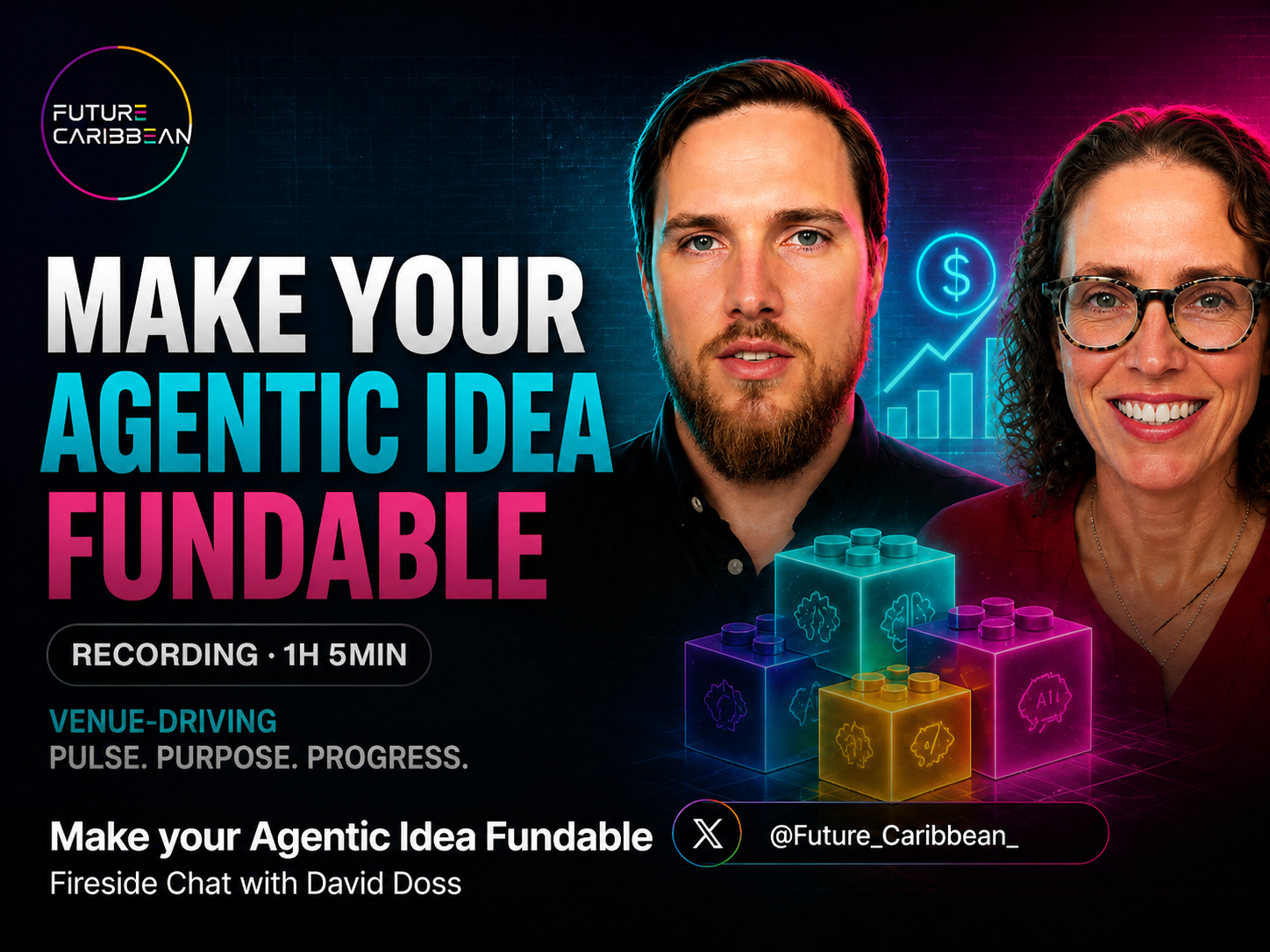
What does it take to turn an AI prototype into a real business — one with customers, revenue, strong intellectual property, strategic partnerships and a path to scale?
That was the central question explored during a Future Caribbean fireside chat hosted by Lily Dash, with Melissa joining David Doss for a conversation on moving AI projects from the buildathon stage into the real world.
Drawing on his experience across emerging technologies, blockchain, AI and financial services, David offered builders an investor-focused perspective on what happens after the prototype is complete. His message was clear: building something is only the beginning. The real challenge is building something people need, will pay for and can actually deploy.
Building is easier. Building a business is not.
AI has dramatically lowered the barriers to creating technology. Founders without traditional coding backgrounds can now take an idea and produce a working prototype in a fraction of the time.
But as more people gain the ability to build, having a functioning product becomes less of a differentiator.
The focus needs to shift toward the business behind the technology.
Who is the customer? What problem is being solved? How quickly can the product generate revenue? What will customers actually pay? And what makes the solution difficult to replicate?
David encouraged builders to think about these questions early rather than waiting until they are ready to raise capital.
A strong prototype may open the door, but traction, revenue potential and a credible go-to-market strategy are what turn an idea into an investable venture.
Build the Lego piece, not the entire skyscraper
One of the strongest ideas from the conversation was the importance of thinking smaller at the beginning.
Founders often have ambitious visions for transforming an entire industry, but David encouraged builders to focus first on a specific problem that can be solved well.
Instead of trying to build an entire ecosystem, build the "Lego piece" that solves one valuable problem.
That first product can generate revenue, establish customer relationships and provide the evidence needed to expand into a much larger opportunity.
For Caribbean founders, this approach can be particularly powerful. A company doesn't have to solve every problem in healthcare, tourism, education or finance on day one. It can identify a specific pain point, prove its value and build outward from there.
The first deployment doesn't have to be the whole vision. It just needs to be a valuable first step toward it.
Make the business defensible
The conversation also highlighted the importance of intellectual property.
In a world where AI tools are increasingly accessible, simply using AI is unlikely to be enough to differentiate a company.
Founders need to think about what they actually own: proprietary technology, workflows, data, infrastructure, patents, trade secrets, customer relationships or a unique business model.
David also highlighted the potential for Caribbean founders to develop intellectual property with global relevance. The region's innovations don't have to remain confined to local markets; solutions designed around Caribbean challenges can serve other emerging markets around the world.
But protecting valuable IP requires thinking ahead. Founders should consider whether aspects of their technology could benefit from protection before publicly releasing or commercializing them.
Revenue before the big valuation
For investors and deployment partners, a huge theoretical market is not enough.
David encouraged founders to think realistically about their addressable market and customer acquisition.
Who can become a customer in the next three months? What could the business look like after one year? What happens at five years?
Understanding metrics such as recurring revenue, revenue per user, customer acquisition costs and the capital required to reach the next stage allows founders to build a more credible investment case.
The goal is not simply to raise money. The goal is to know exactly what that money will help the company accomplish.
Start where you can actually deploy
Healthcare provided a useful example of this principle.
A founder may want to transform an entire healthcare system with AI, but highly regulated industries can make large-scale deployment slow and complicated.
Instead, David encouraged builders to identify adjacent opportunities that can be deployed more quickly. A booking platform, administrative tool or other solution that does not require extensive access to sensitive patient information may provide a much easier entry point.
The larger vision doesn't disappear. The founder simply finds a commercially viable starting point that can generate traction, build relationships and create a pathway toward larger opportunities.
A great product still needs a great go-to-market
Perhaps the biggest lesson from the conversation was that building a great product does not guarantee success.
As AI makes development faster, distribution becomes even more important. Founders need to understand how they will reach customers, create demand and turn initial interest into sustainable adoption.
David emphasized the importance of an ongoing feedback loop between product development, marketing and sales. Customer feedback should continuously improve the product, while a deep understanding of the product should shape how it is positioned and sold.
In other words: a strong product without distribution can disappear. A strong product with an excellent go-to-market strategy has a much better chance of becoming a business.
Keep the human advantage
Despite the conversation's focus on AI and automation, one of David's strongest messages was about something technology cannot easily replicate: human connection.
As AI makes it easier to generate products, content and strategies, authenticity becomes more valuable.
Founders shouldn't rely entirely on AI to determine their strategy or their voice. Genuine relationships with customers, partners and communities remain essential. AI can accelerate those relationships, but it shouldn't replace them.
For Caribbean entrepreneurs, this human element may be particularly powerful. Trust, relationships and community are already deeply embedded in the region's business culture and can become part of a company's competitive advantage.
From buildathon to balance sheet
The Future Caribbean Buildathon gives builders the opportunity to move quickly from an idea to a working prototype. But the fireside chat with David Doss reframed what comes next.
The journey doesn't end at the demo. It moves from prototype to validation, validation to customers, customers to revenue, and revenue to scale.
The most successful ventures may not be those with the most complicated technology. They may be the ones that identify a genuine problem, build a focused solution, understand their customer, develop a strong go-to-market strategy and create something they can actually own.
For Caribbean founders, that creates an exciting opportunity. The tools to build are becoming more accessible than ever.
Now comes the harder — and more important — part: turning Caribbean ideas into real businesses that can attract capital, secure partnerships, generate revenue and create lasting value.
Inside Future Caribbean's 12-Hour Demo Day: The Projects Presented
Across ten tracks, Caribbean innovators explored how AI could respond to real challenges — from energy and transportation to finance, climate resilience, healthcare, and the creative economy.
A Glimpse Into Future Caribbean's Demo Weekend
A weekend celebrating Caribbean innovation, AI-powered problem-solving, and the people building solutions for the region's future.