Rebuilding the Caribbean Real Estate Economy
Inside a Future Caribbean session on PropTech, eConveyancing and circular economics — why the region can't tokenize a broken system, and how Agentic AI could turn nine-month property transactions into digital infrastructure.

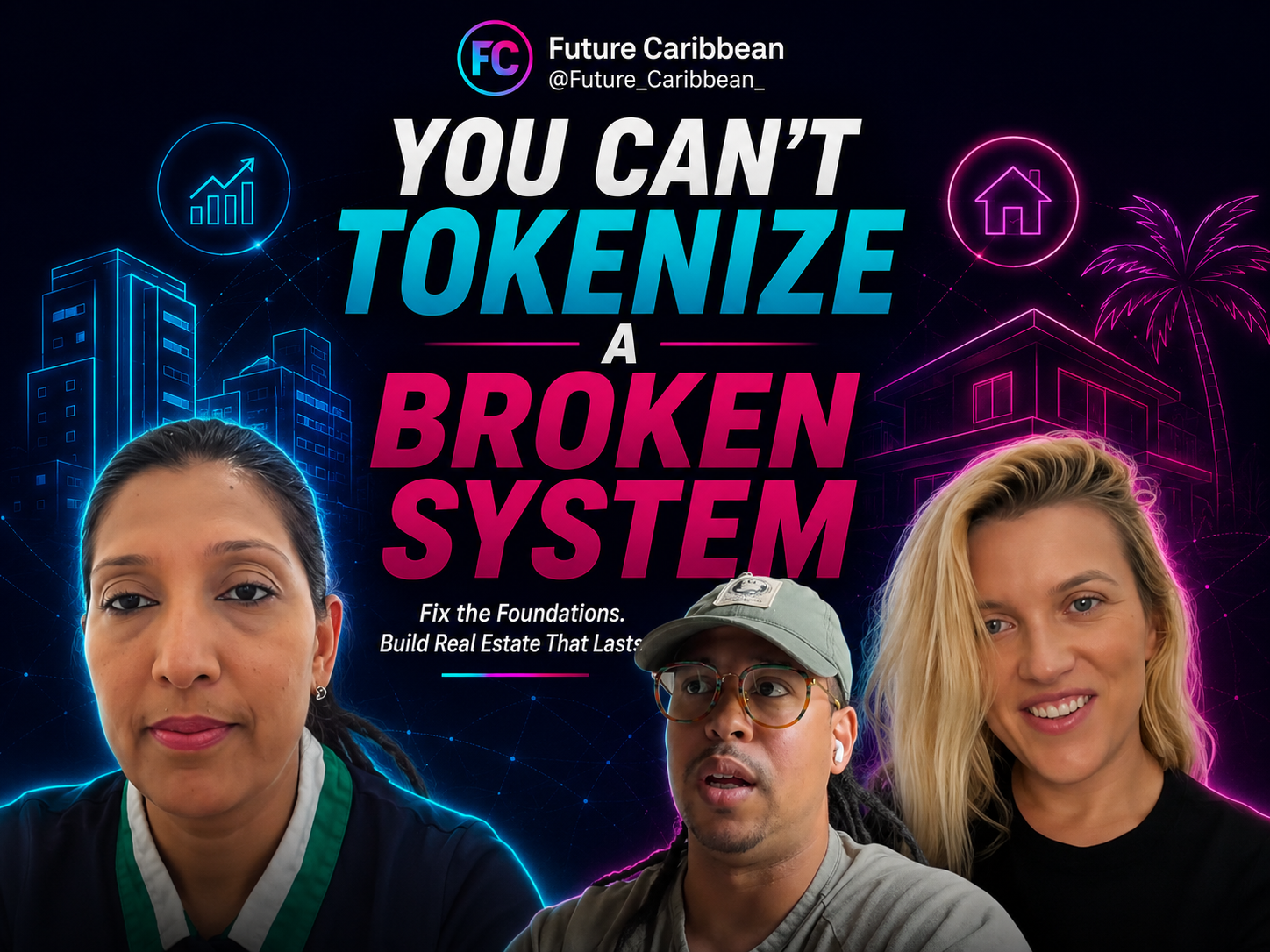
What if buying, selling, investing in, and managing property across the Caribbean could be as seamless as booking a flight or making a digital payment?
That was the central question behind a recent Future Caribbean brainstorming session hosted by Lily Dash, bringing together builders and advisors to explore how Agentic AI, digital infrastructure, eConveyancing, tokenization and circular economics could fundamentally reshape the region's real estate ecosystem.
The conversation began with a practical problem: Caribbean real estate is an enormous asset class, but the systems supporting it remain highly fragmented.
From outdated MLS platforms and spreadsheets to manual land registries and lengthy conveyancing processes, the infrastructure often struggles to keep pace with the value and demand moving through the market.
The opportunity, however, is enormous.
Building the Caribbean's Real Estate Operating System
Adam introduced Yadifi, a real estate hub and centralized marketplace being developed with the Caribbean in mind, with Jamaica currently serving as its primary market and testing ground.
The platform brings together three core components: a property listings portal, a CRM and an analytics platform.
But what makes the vision particularly interesting is the way Agentic AI can eventually interact with the underlying system.
Rather than AI simply answering questions, Yadifi is being designed with APIs that allow agents to perform the same actions a human user could perform inside the platform.
An AI agent could identify which buyers should be followed up with first, evaluate buyer intent, surface relevant properties and—subject to human approval—initiate communications through channels such as WhatsApp.
The longer-term vision goes much further.
A buyer could tell an AI agent what type of property they are looking for, their location and budget. The agent could search available properties, communicate with other agents, coordinate viewings and communicate with the buyer throughout the process.
The objective isn't simply to put AI on top of a real estate website.
It's to create infrastructure where AI can actually do work.
The Real Innovation May Be Making Real Estate Easier
One of the strongest points raised during the discussion was that Caribbean technology has to solve the region's very specific problem of limited economies of scale.
Real estate professionals are often doing the work of several people at once.
For an agent in the field, something as simple as uploading a new property can become a surprisingly time-consuming process: taking photographs, collecting property details, recording the owner's information, finding the location, returning to the office and then manually entering everything into multiple systems.
Lily proposed a much simpler model: a WhatsApp-based agent that allows a real estate professional to send photographs, property information, contact details and location data directly to an AI agent.
By the time the agent returns to the office, the property could already be structured and ready to appear across the relevant platforms.
It's a deceptively simple idea—but that's exactly the point.
The next generation of Caribbean PropTech cannot simply replicate existing platforms.
It has to create a level of convenience and value that makes adoption a no-brainer.
Turning Fragmented Data Into Usable Infrastructure
Another important element of Yadifi's approach is how the platform handles data.
Rather than allowing information to remain trapped in disconnected systems, the platform is being designed around standardized and normalized data so that information entered once can be used across different functions.
That opens the door to much more powerful automation.
Existing MLS data could be integrated directly into the platform. Information stored in Excel spreadsheets could be uploaded and parsed by an agent, extracting details such as addresses and parcel information and automatically creating property and listing records.
The platform is also exploring connections to geographic and land information systems.
Instead of a realtor having to navigate multiple disconnected government portals to investigate a property, questions such as whether an area has historically flooded could eventually be answered directly through the platform.
Land ownership and parcel information could similarly become much easier to access.
This is where PropTech begins to evolve into something bigger: a connective layer between the systems that already exist.
Real Estate Is More Than Property—It's Economic Infrastructure
The conversation then expanded beyond technology and into a much larger question: what kind of economic infrastructure should the Caribbean be building?
Emanuel introduced the concept of circular economics and the need to move away from extractive systems toward models that allow value, capital and resources to circulate within Caribbean communities.
His work looks at circularity not simply as an environmental concept, but as a framework for human and economic sustainability, sovereignty and data ownership.
The idea challenges the traditional model in which Caribbean resources and economic activity generate value that ultimately flows outward.
Instead, the goal is to build systems that allow value to remain, compound and create additional opportunities within the region.
That concept has significant implications for real estate.
Property is one of the most important stores of wealth in the Caribbean. If the infrastructure surrounding property ownership, investment and transactions can be modernized, real estate could become a much more powerful engine for regional wealth creation.
Unlocking the Caribbean Diaspora
The discussion also explored the enormous potential of the Caribbean diaspora as a source of investment.
Emanuel suggested that platforms like Yadifi could eventually create mechanisms for people outside the Caribbean to participate in regional real estate through crowdfunding or other shared investment models.
The appeal is straightforward.
Millions of people with Caribbean connections live outside the region, yet investing in Caribbean real estate can be difficult because of fragmented information, complex processes and limited access to trustworthy market data.
Better digital infrastructure could make those opportunities significantly more accessible.
Tokenization could take that concept even further by creating new ways for people to participate in real-world assets.
But there was an important caveat: tokenization is not the starting point.
The foundations have to come first.
You Can't Tokenize a Broken System
Lily highlighted a critical point from her own experience working in the tokenization space: the Caribbean cannot simply jump to blockchain and tokenized assets without first modernizing the underlying infrastructure.
If it takes months to register or transfer property, digitizing the ownership of that property doesn't solve the fundamental problem.
If land records are fragmented, there is no reliable digital asset to tokenize.
If regulations are unclear, investment platforms cannot scale.
If banks and government systems cannot communicate through APIs, transactions still require manual intervention.
The infrastructure has to be modernized first.
Only then can the region begin creating new, globally accessible asset classes that could attract significantly more capital.
The Nine-Month Real Estate Transaction Problem
That brings the conversation to one of the biggest challenges discussed during the session: eConveyancing.
Lily presented eConvey as a proposed pathway toward modernizing Caribbean land administration, drawing on research across major global real estate markets.
In Barbados, Lily highlighted that real estate represents a substantial portion of national wealth, while the land registry processes billions of dollars in property transactions. Yet transactions can take approximately nine months to close.
For a modern economy, that creates enormous friction.
A transaction that takes nine months ties up capital, delays developers, creates uncertainty for buyers and sellers, increases legal costs and makes the market less attractive to international investors.
The problem becomes even more serious when transaction volumes increase.
A manual system that can barely process today's transactions will break down even further as the market grows.
As Lily explained during the session, the Caribbean needs systems that can scale with the economy rather than systems that become slower as economic activity increases.
From Manual Deeds to Digital Titles
At the heart of the proposed solution is a shift from traditional deed-based systems toward modern registered land systems.
Much of the Caribbean continues to operate with unregistered or manually intensive land systems, requiring lawyers to conduct extensive historical due diligence to establish ownership.
In a registered Torrens-style system, the government maintains the authoritative record of ownership, creating greater certainty around title.
The opportunity is to make that system digital.
A future eConveyancing platform could allow landowners to submit documentation digitally, use AI to assist with title abstraction and validation, maintain human oversight where necessary, and ultimately register titles electronically.
Lily described a potential process in which documents are submitted, AI assists with validation, a human remains in the loop for review, and approved titles can be registered and represented through a digital title certificate.
This is where Agentic AI becomes particularly powerful.
AI doesn't need to replace lawyers or land registries. It can handle the enormous amount of repetitive information processing that currently consumes their time.
What If AI Could Do the Paperwork?
One of the most compelling ideas from the session was AI-assisted title abstraction.
A title abstract requires reviewing historical documents and extracting the information necessary to establish ownership and the chain of title.
Today, that process can involve significant amounts of manual legal work.
But AI has the ability to search, classify, summarize and cross-reference large volumes of documents with speed and consistency.
Lily described AI-assisted abstraction as one of the easiest opportunities to implement, with the potential to dramatically reduce the amount of manual work involved in processing property records.
The human lawyer doesn't disappear. Instead, the lawyer moves from manually searching through mountains of documents toward reviewing AI-generated work, resolving exceptions and exercising professional judgment.
That's the broader Agentic AI opportunity: automate the process, keep humans accountable for the decisions that matter.
APIs, Blockchain and the Infrastructure Beneath the Transaction
Modern eConveyancing requires more than digitizing documents. It requires systems that can communicate.
Lily highlighted the importance of APIs for connecting banking systems, land registries, cadastral information, electronic lodgement networks and other parts of the transaction.
Today, even determining whether funds have been received can require manual confirmation. In a genuinely digital system, a payment could automatically trigger the next stage of a transaction.
A modern eConveyancing ecosystem could therefore bring together:
- Geographic information systems
- Electronic cadastral systems
- Electronic lodgement networks
- Digital land registration
- Interbank payment infrastructure
- Digital identity
- AI-assisted title processing
- Blockchain-based records
The result would be a system in which information doesn't simply become digital—it becomes interoperable.
Giving Residents More Power
The conversation also touched on a different but equally important dimension of real estate technology: the resident.
Sam Peacock shared work on a resident-first platform designed around resident empowerment.
The concept focuses on reducing the information imbalance that often exists between landlords and residents by helping people understand their rights and obligations when entering into contracts.
Instead of forcing residents to navigate complex legal language on their own, an AI-powered system could explain what an agreement means, what obligations apply and what rights the resident has.
This introduces another important principle for Caribbean digital infrastructure: technology shouldn't only make transactions faster for institutions. It should make systems easier to understand for ordinary people.
Building Systems That Keep Value in the Caribbean
Ultimately, the session connected several ideas that might initially appear unrelated: a real estate marketplace, an AI-powered CRM, digital land registries, eConveyancing, tokenization, resident empowerment, circular economics and blockchain.
But together, they point toward the same vision.
A Caribbean where the foundational systems surrounding land and property are digital, interoperable, accessible and designed to allow value to circulate within the region.
Where a real estate agent can list a property from WhatsApp.
Where an AI agent can coordinate a transaction.
Where a lawyer can review an AI-generated title abstraction instead of spending hours searching through paper records.
Where a buyer can access reliable property information.
Where a resident can understand their legal rights.
Where a Caribbean citizen abroad can participate in investment opportunities back home.
And where property can eventually become a globally accessible digital asset—because the infrastructure underneath it is finally strong enough to support it.
From Fragmentation to Infrastructure
The most powerful takeaway from the session was that none of these problems can be solved in isolation.
Yadifi cannot transform Caribbean real estate alone. Neither can a government land registry. Neither can blockchain. Neither can AI.
The region needs builders, governments, financial institutions, lawyers, developers, real estate professionals and communities working toward a shared direction.
As Lily emphasized during the discussion, the opportunity lies in bringing these stakeholders together and creating a shared source of truth around what is possible.
The Caribbean already has the assets. It has the people. It has the capital. It has the technology.
What it needs is the infrastructure to connect them.
And that is where Agentic AI could become more than another technological trend. It could become part of the infrastructure that allows the Caribbean to own, move, invest and build value differently.
Inside Future Caribbean's 12-Hour Demo Day: The Projects Presented
Across ten tracks, Caribbean innovators explored how AI could respond to real challenges — from energy and transportation to finance, climate resilience, healthcare, and the creative economy.
A Glimpse Into Future Caribbean's Demo Weekend
A weekend celebrating Caribbean innovation, AI-powered problem-solving, and the people building solutions for the region's future.