Agentic AI for Climate Risk & Disaster Coordination: Building a More Resilient Caribbean
Inside a Future Caribbean session with the UNDP's Eric Loubaud and builder Nick Hurley — localized models, mesh networks, digital twins and data sovereignty as the missing coordination layer for Caribbean disaster response.

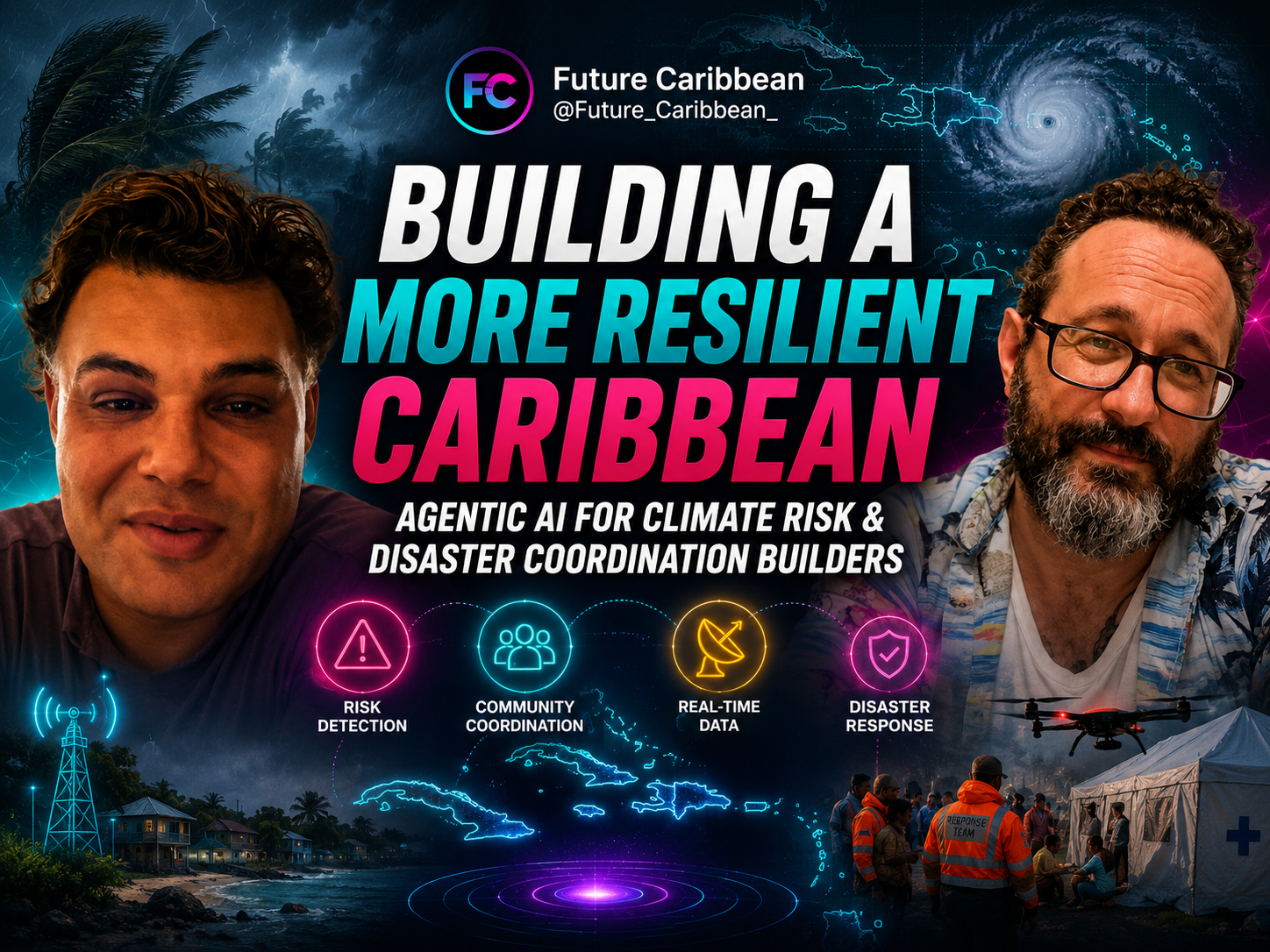
The Caribbean is one of the world's most disaster-exposed regions, yet its disaster-management infrastructure remains highly fragmented.
That was the central theme of a Future Caribbean working session hosted by Lily Dash, bringing together disaster-risk expert Eric Loubaud of the UNDP, builders including Nick Hurley, and members of the wider Future Caribbean community to explore how Agentic AI, localized models, mesh networks, sensor infrastructure and data sovereignty could fundamentally change how the Caribbean prepares for and responds to climate disasters.
The conversation quickly revealed that the challenge isn't simply a lack of technology.
The bigger problem is that the technology, data and institutions that already exist don't communicate with one another.
The Caribbean Doesn't Have a Regional Disaster Operating System
Lily opened the discussion with a stark observation: despite being one of the world's most disaster-prone regions, the Caribbean does not have a genuinely smart, interconnected disaster-management system.
Disaster response remains fragmented between governments, private companies, telecommunications providers and different agencies. During a disaster, organizations can end up working independently, trying to determine where people are, where they need to go and what resources are available.
This becomes particularly problematic because telecommunications companies possess information that could be incredibly valuable during emergencies.
Mobile networks can provide insight into population movement in real time. That means telecom infrastructure could potentially help authorities understand where people are moving before, during and after hurricanes, floods or other disasters—and communicate warnings directly to affected populations.
The technology exists in pieces.
What is missing is coordination.
From Reaction to Prediction
Eric Loubaud, a disaster-risk reduction and recovery specialist with the UNDP's regional hub for Latin America and the Caribbean, emphasized that disaster management cannot simply mean responding after something has already happened.
The goal needs to be: prepare → anticipate → respond → recover.
One of the fundamental problems is that disaster-related information exists across multiple systems.
Meteorological data may sit in one system. Water-resource information may sit somewhere else. Security information may exist independently. Health information may be managed separately.
These systems frequently operate in silos and don't communicate with one another, making it difficult to understand the systemic impacts of a disaster.
Agentic AI could provide the intelligence layer connecting these otherwise disconnected systems.
Rather than simply producing another dashboard, an agent could continuously collect information from different sources, interpret what is happening and help determine what action should happen next.
AI as the Coordination Layer
Nick Hurley proposed an approach based around an intelligence layer that allows otherwise disconnected systems to share information through a common database.
The architecture could incorporate existing infrastructure—including cameras, microphones and other sensors—while allowing new technologies to be added over time.
The important idea is that the system shouldn't require every organization to replace everything it already has.
Instead, the AI layer becomes the connective tissue between existing infrastructure.
That could allow information from multiple sources to be correlated in real time. Seismic information from one island could potentially move through a regional network while additional data is continuously incorporated. Wave information, sensor data and other environmental signals could then be combined to model what might happen next.
The system could potentially move from "Something is happening." to "Here is what is happening, here is what is likely to happen next, and here is what authorities should prepare for."
The Power of Localized AI
One of the most compelling technical discussions centered on small, specialized AI models.
The Caribbean doesn't necessarily need to run enormous frontier models for every disaster-management task.
Nick argued that smaller models could be deployed locally and trained or configured around regional data and specific use cases.
That has two major advantages.
1. Relevance. A model built around Caribbean-specific information can provide context that a generic model trained primarily on North American or European data may lack. Nick specifically described the value of smaller models that contain the correct local context rather than relying entirely on larger models whose underlying assumptions may not apply to Caribbean environments.
2. Sovereignty. If critical disaster infrastructure depends entirely on a foreign AI provider, the Caribbean could potentially become dependent on decisions made outside the region. Nick raised the concern that if an AI system is built on top of a foreign frontier model, a government or company in another jurisdiction could theoretically restrict access to that model even if the Caribbean organization itself had done nothing wrong.
For disaster infrastructure, that is an unacceptable dependency.
The alternative is to maintain localized intelligence that can continue operating under Caribbean control.
What Happens When the Internet Goes Down?
This is where the concept of mesh networks becomes particularly powerful.
Imagine a major hurricane hits Barbados. Power infrastructure is damaged. Internet connectivity goes down. Cloud services become inaccessible. Traditional disaster-management systems suddenly lose their ability to communicate.
A locally distributed network could continue operating.
Nick described a model where smaller nodes communicate directly with one another, creating a local network that can continue transmitting critical information even when the broader internet is unavailable.
The system wouldn't necessarily need to stream high-definition video. It could prioritize the information that actually matters:
- Emergency text
- Sensor readings
- Population movement
- Seismic information
- Weather observations
- Environmental data
- Alerts
- Local instructions
A node in one location could pass information to another node, creating a resilient communications layer that doesn't depend entirely on a single centralized connection.
And because these networks could potentially span islands, the concept extends beyond individual countries toward regional resilience infrastructure.
Disaster Intelligence That Works During the Disaster
The most exciting part of the proposed architecture is that it wouldn't necessarily stop at monitoring.
The AI could simulate possible outcomes while an event is occurring.
Nick described the possibility of correlating different types of environmental information and running simulations in real time to estimate potential fallout.
That creates the possibility of something closer to a live digital model of a disaster.
A hurricane changes direction; the system updates its model. Population movement changes; the system incorporates telecom data. Flooding begins in a particular area; the system incorporates environmental and geographic information. Infrastructure is damaged; the system adjusts its projections.
Authorities then receive an updated picture of where the greatest risks are likely to emerge.
This could allow disaster management to become increasingly predictive rather than reactive.
Digital Twins for Caribbean Islands
The broader vision discussed in the session points toward creating digital representations of Caribbean environments.
These could eventually incorporate geography, weather, population movement, infrastructure, housing, roads, utilities, environmental sensors, historical disaster data and climate projections.
The goal would be to simulate how different events cascade through an island.
A hurricane isn't simply a weather event. It can trigger flooding. Flooding can disrupt roads. Road disruption affects supply chains. Supply-chain disruption affects food and fuel. Infrastructure damage affects telecommunications. Population displacement creates new housing and health pressures.
A genuinely intelligent disaster system therefore needs to understand relationships between systems, not simply individual hazards.
Eric emphasized precisely this challenge: disaster impacts are complex and cross-sectoral, requiring different information systems to work together so authorities can better anticipate, mitigate, respond to and recover from impacts.
Turning Climate Data Into Action
Eric also discussed UNDP work using AI to address gaps in climate-loss-and-damage data.
One challenge across the region is simply that there isn't enough historical data to understand every possible scenario. AI can help bridge some of that gap by combining available historical information with climate models, development scenarios and expert knowledge.
The resulting intelligence can help estimate potential disaster risks and produce impact-based warnings.
Instead of simply telling authorities "a hurricane is coming," the system could move toward: based on the expected conditions, these communities, infrastructure systems and sectors are most likely to experience these impacts.
That distinction is crucial. Because the purpose of a warning isn't merely to provide information. It is to enable action.
The Last-Mile Problem
Even the world's best AI system is useless if the warning never reaches the person who needs it.
That is why telecommunications infrastructure emerged as such an important part of the conversation.
The last mile matters. Authorities need to know:
- Who is in the affected area?
- Where are people moving?
- Who needs evacuation?
- Which communities have lost connectivity?
- Where should emergency resources be sent?
- How can instructions reach people immediately?
Telecom companies potentially have some of the most valuable real-time data for answering those questions. But the region needs mechanisms that allow governments, telecoms, disaster agencies and technology providers to coordinate around that information.
Data Sovereignty Is Disaster Resilience
The discussion around sovereignty went beyond simply keeping information inside Caribbean borders.
It's about ensuring that the region has control over the systems that become essential during a crisis.
Nick argued that Caribbean data shouldn't automatically have to leave the region or sit entirely under the jurisdiction of foreign companies. If data is controlled externally, foreign governments or corporations may ultimately have influence over how that infrastructure operates.
Imagine a Caribbean island's emergency-response infrastructure depending entirely on an overseas cloud service. If connectivity fails, the system fails. If access to a model is restricted, the system fails. If the provider changes its pricing or policies, the system becomes vulnerable.
Local AI, local networks and local data infrastructure therefore aren't just technology choices. They become elements of national and regional resilience.
Climate Resilience Starts Before the Hurricane
The discussion also connected disaster management with another major Caribbean challenge: housing.
Lily highlighted the region's housing shortage and the need for more resilient housing infrastructure.
The opportunity isn't simply to build more homes. It is to build housing that can withstand the environmental realities of the Caribbean.
Modular construction, resilient materials and disaster-ready housing could become part of a larger resilience strategy—particularly when paired with new financing mechanisms that allow Caribbean capital and international liquidity to fund these projects.
Building "Settler" Infrastructure for Resilience
Lily connected the disaster conversation to an earlier discussion about the Caribbean's historical economic structure.
The argument was that many Caribbean systems were historically designed around extraction rather than allowing capital and wealth to remain, compound and grow within the region.
The alternative is infrastructure that can hold capital, custody it, syndicate it and allow wealth to compound.
Climate resilience requires exactly this type of infrastructure. A resilient Caribbean needs capital that can fund disaster-resistant housing, communications infrastructure, local AI systems, sensor networks, energy infrastructure, emergency logistics, climate adaptation and infrastructure reconstruction—and financial mechanisms capable of mobilizing that capital quickly.
In that sense, climate resilience isn't only an environmental problem. It is an infrastructure and capital-allocation problem.
The Bigger Vision
What emerged from this session was a vision for a Caribbean disaster-management system that looks fundamentally different from today's fragmented model.
AI systems need access to localized information. Communities need resilient communication networks. Financial infrastructure needs to fund adaptation. Housing needs to be designed around climate realities. And the intelligence layer needs to connect all of it.
The Caribbean can't prevent hurricanes, floods, droughts or other climate events.
But it can change what happens after the warning arrives—and even before it does.
Agentic AI offers the possibility of moving from fragmented systems and reactive response toward something much more powerful: a Caribbean-wide intelligence and coordination layer built around local data, local infrastructure and regional sovereignty.
Inside Future Caribbean's 12-Hour Demo Day: The Projects Presented
Across ten tracks, Caribbean innovators explored how AI could respond to real challenges — from energy and transportation to finance, climate resilience, healthcare, and the creative economy.
A Glimpse Into Future Caribbean's Demo Weekend
A weekend celebrating Caribbean innovation, AI-powered problem-solving, and the people building solutions for the region's future.