What Could We Build That Genuinely Changes the Way Caribbean Tourism Works?
Inside the Future Caribbean brainstorming session on Agentic AI for Tourism — airlift mismatches, direct bookings, fragmented data, and the case for a connected regional tourism economy.

What could we build that genuinely changes the way Caribbean tourism works?
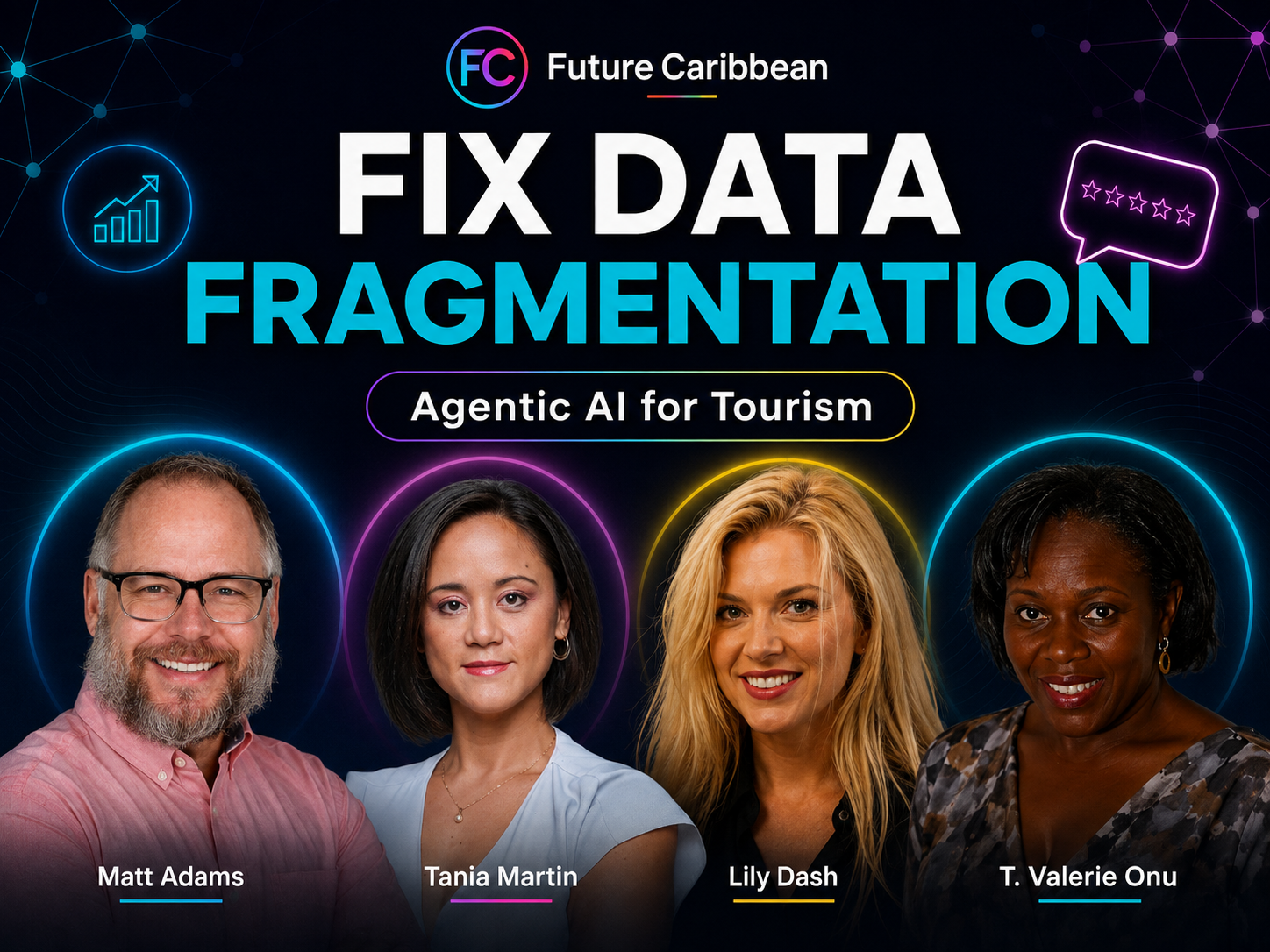
That question shaped a Future Caribbean brainstorming session on Agentic AI for Tourism, bringing together builders, tourism professionals and advisors to explore how artificial intelligence could address some of the Caribbean's biggest structural challenges — from fragmented data and costly booking intermediaries to airlift, supply chains and the lack of connected digital infrastructure.
Hosted by Lily Dash, the session featured tourism leader Tania Martin, alongside builders developing solutions across hospitality, travel, medical tourism, real-time intelligence and regional commerce.
The conversation quickly moved beyond the idea of simply using AI to recommend restaurants or create holiday itineraries.
Think bigger than the concierge
Tania Martin opened the session with a challenge to builders: think bigger.
With more than 300 properties under management through her villa business, operations in Barbados and St. Lucia, and years of experience representing the villa sector through the Barbados Hotel and Tourism Association, Tania brought a perspective grounded in the realities of Caribbean tourism.
She pointed out that many of the tourism applications being developed focus on concierge services, recommendations and itinerary planning — areas where existing AI tools can already provide significant functionality.
The bigger opportunity lies in solving the problems that currently prevent the Caribbean tourism industry from operating as a truly connected system.
With more than 35 million visitors coming into the Caribbean each year, the region represents an enormous source of tourism data and commercial activity. The question is how that information can be connected and used to create value across multiple islands rather than remaining trapped within individual businesses and destinations.
A Caribbean tourism system, not 30 separate markets
One of the most compelling ideas discussed was the possibility of creating a shared digital layer for Caribbean tourism.
Today, individual islands often compete for the same visitors, flights and resources. Yet the challenges facing one destination can directly benefit another.
Tania highlighted an example involving airlift. One destination may have accommodation available but insufficient flights, while another may have available flights but accommodation that is already full.
An intelligent system could potentially use live data to identify these mismatches and help redirect demand and capacity across destinations.
Instead of every island operating independently, Agentic AI could help the region understand where demand exists, where capacity is available and where resources need to move.
The goal isn't necessarily to make Caribbean destinations identical. It is to make them better connected.
Reclaiming direct bookings
Another major challenge is the amount of revenue Caribbean businesses lose through intermediaries.
Hotels and villas frequently depend on large tour operators, online travel agencies and travel advisors to bring customers to their properties. While these networks provide valuable distribution, they also take a significant portion of the booking value.
Tania raised the possibility of creating a Caribbean-focused platform that could allow properties to capture more direct business while still providing the convenience and discovery customers expect from global booking platforms.
This idea became particularly relevant during Eric Sanchez's demonstration.
Eric presented an Agentic Commerce layer for hospitality, designed to help hotels and villas convert more direct bookings through an AI-powered concierge.
The system could answer questions, communicate with potential guests, recommend rooms and amenities, and guide customers through the booking process. The demonstration showed how an AI agent could move beyond answering questions to actually supporting the customer journey toward a booking.
The bigger opportunity, however, was taking that technology beyond an individual property.
Tania challenged Eric to move further up the funnel: rather than waiting for a traveller to find a specific hotel, could the system help someone decide which Caribbean island is right for them in the first place?
Eric immediately saw the opportunity to expand the concept into a regional discovery and booking layer — from choosing the Caribbean destination, to selecting accommodation, to completing the booking.
Connecting fragmented tourism data
Data fragmentation emerged as one of the biggest obstacles — and opportunities — in the discussion.
Tourism businesses often use multiple systems for property management, distribution, accounting, CRM and point-of-sale operations. These systems don't always communicate with each other, leaving businesses to manually move information between platforms.
The result is a huge amount of valuable data that exists but isn't being effectively connected or used.
Tania described the problem as a lack of a bridge between systems that are each designed to perform one function.
For Agentic AI, this creates an enormous opportunity.
Rather than simply placing a chatbot on top of existing systems, AI agents could potentially act as the connective tissue between them — helping businesses understand demand, manage inventory, improve operations and make decisions using information that currently sits in disconnected silos.
From local knowledge to real-time intelligence
Matt, known as Hammertoe, demonstrated another approach through Pulse, a system designed to create a real-time knowledge layer from publicly available Caribbean information.
The architecture brings together sources including radio stations, news websites, government websites and other local platforms, then processes that information through an extraction and agentic curation system.
The significance goes beyond simply aggregating news. Live local information could become infrastructure for other tourism applications.
A concierge agent, travel-planning system or destination-management platform could potentially use that constantly updated knowledge to provide more accurate information about what is happening on the ground.
This creates an opportunity to turn local knowledge into digital infrastructure that other systems can build upon.
Connecting the entire visitor journey
Another builder, Thierry Gittens, demonstrated a multi-agent platform designed to connect tourism with other aspects of the Caribbean experience.
His platform brings together tourism, transportation, real estate and personal finance rather than treating them as separate experiences.
Travellers can plan trips based on their budget, dates and interests, discover activities, manage their itinerary and explore accommodation. The platform also extends beyond the trip itself, with tools designed to help users manage expenses and finances after they return home.
The concept reflects a broader idea discussed throughout the session: the visitor shouldn't have to move between dozens of disconnected platforms to manage one journey.
The opportunity is to create a more seamless digital experience across the entire lifecycle of travel.
Medical tourism and frictionless travel
The discussion also expanded beyond traditional leisure tourism.
Theon Morales presented a concept focused on medical tourism, using AI agents to make the process of researching and arranging travel more frictionless.
His approach envisioned users being able to communicate with AI agents conversationally rather than navigating multiple forms and systems. The system could research destinations, provide relevant information and support the traveller throughout the process.
Because medical tourism involves higher levels of risk and sensitivity, the discussion also highlighted the importance of appropriate guardrails and industry-specific knowledge when deploying AI in this space.
The user experience matters
The technology may be powerful, but the advisors repeatedly returned to one fundamental question: will people actually use it?
Feedback from Valerie Onu emphasized the importance of making tourism platforms more visual, interactive and intuitive, particularly for mobile users.
Rather than presenting travellers with large amounts of information to read, builders were encouraged to think about faster, more engaging interactions that reduce the amount of work required from the user.
Voice interfaces, visual content and personalized journeys could all help make AI-powered tourism tools feel more natural.
The message was consistent with Tania's earlier challenge: technology should not simply add another layer of complexity. It should remove friction.
Building infrastructure for the Caribbean
The session ultimately moved toward a much larger vision.
The Caribbean has the opportunity to use Agentic AI not simply to create better travel apps, but to build the digital infrastructure that connects tourism businesses, destinations, travellers, airlines and local service providers.
Imagine a system that understands demand across the region. A platform that knows where rooms are available, where flights have capacity and where travellers are looking to go. A booking layer that helps properties reduce their dependence on expensive intermediaries. An intelligence system that captures what is happening across local communities in real time. And an AI-powered interface that makes the entire journey — from choosing an island to booking accommodation and experiences — feel seamless.
That is considerably bigger than an itinerary generator. It is a vision for a connected Caribbean tourism economy.
The brainstorming session demonstrated that the technology to begin building this future is increasingly accessible. The bigger challenge is deciding which problems are important enough to solve, how to connect existing systems, and how to create solutions that can operate across borders and benefit the region as a whole.
As Tania put it, the opportunity is not to build another small tool that solves one isolated problem. It is to ask: What could we build that genuinely changes the way Caribbean tourism works?
That is where Agentic AI could move from being an interesting technology to becoming critical infrastructure for the Caribbean's next generation of tourism.
Inside Future Caribbean's 12-Hour Demo Day: The Projects Presented
Across ten tracks, Caribbean innovators explored how AI could respond to real challenges — from energy and transportation to finance, climate resilience, healthcare, and the creative economy.
A Glimpse Into Future Caribbean's Demo Weekend
A weekend celebrating Caribbean innovation, AI-powered problem-solving, and the people building solutions for the region's future.