Brainstorming the Future of Trade with Agentic AI
Inside Future Caribbean's Agentic AI for Trade & Regional Commerce session with Automotive Art's Dereck Foster and EY Parthenon's Samantha Conyers — customs complexity, logistics intelligence, product discovery and trusted digital coordination.

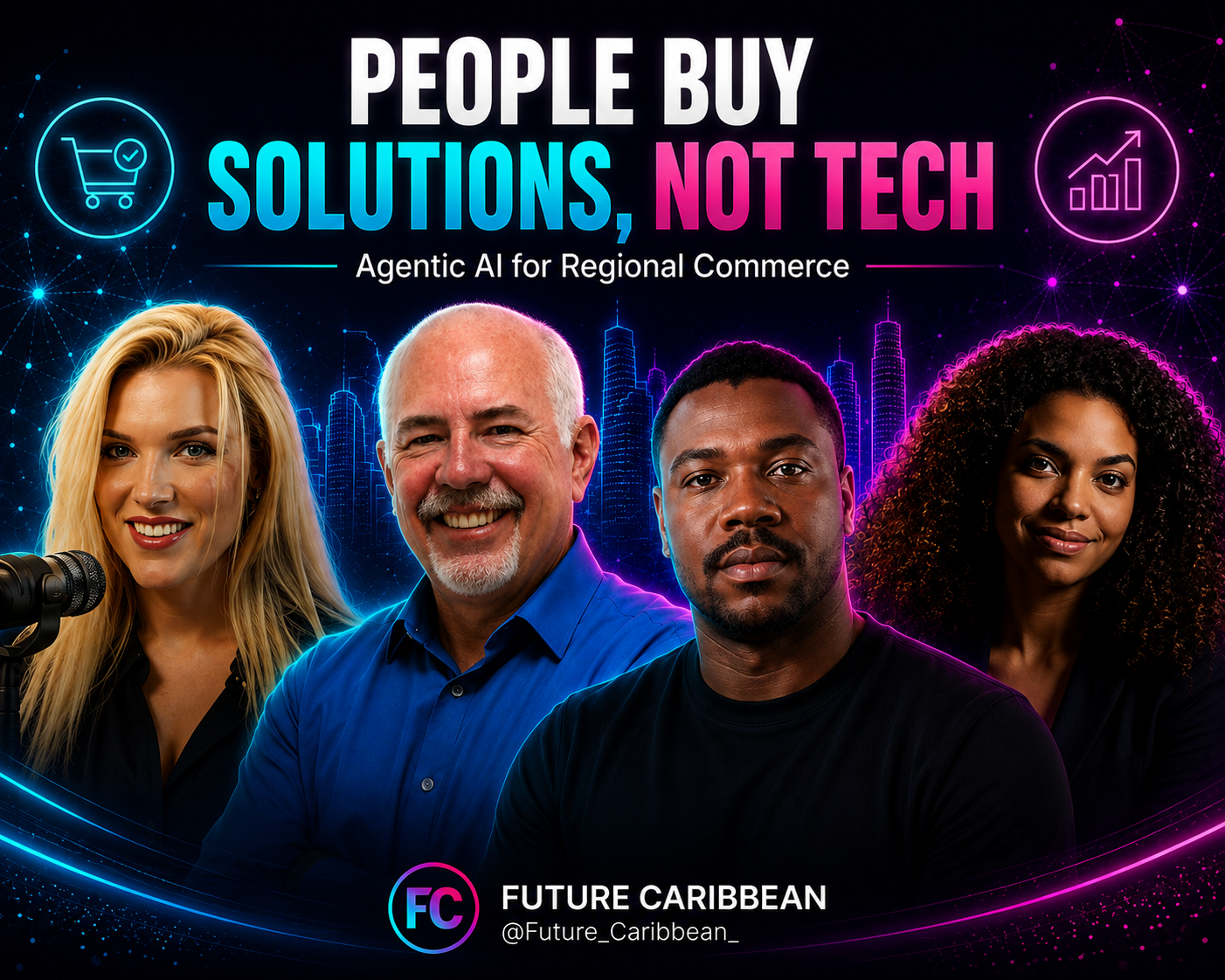
Future Caribbean brings builders, entrepreneurs and industry experts together to explore how Agentic AI could help break down the barriers to regional commerce.
What would it take to make it genuinely easier to do business across the Caribbean?
That was the central question behind Future Caribbean's Brainstorming Session on Agentic AI for Trade & Regional Commerce, hosted by LilyDash and Melissa, with industry insights from Dereck Foster, Founder & CEO of Automotive Art, and Samantha Conyers of EY Parthenon.
With 38 attendees, the conversation moved beyond AI as a technology and focused on a much bigger challenge: the fragmented systems, regulations, logistics and financial infrastructure that make regional trade unnecessarily difficult.
The Caribbean has the talent. The systems are the constraint.
Dereck Foster shared lessons from building Automotive Art from Barbados into a company operating across 75+ countries.
One of the biggest challenges he identified was not a lack of Caribbean talent or entrepreneurial ability. It was the environment businesses have to operate within.
Shipping, customs, excise, permits and inconsistent processes can turn relatively simple transactions into lengthy exercises. Containers can take weeks to clear, while comparable processes in places such as the US or EU can happen within hours.
For Dereck, this raises an important opportunity for AI: help businesses navigate complexity rather than simply automate existing processes.
Could AI become a regional trade navigator?
One of the strongest ideas to emerge was an AI-powered system that understands the different rules governing trade across Caribbean jurisdictions.
Dereck pointed to a simple but significant problem: regulations around imports, licensing, labeling and customs can differ from one island to another — and sometimes the rules or interpretations aren't clearly documented.
An intelligent trade agent could answer questions such as:
- Can I import this product into Barbados?
- What licenses do I need in Jamaica?
- What are the labeling requirements in St. Lucia?
- What duties or tariffs apply?
- What documentation is required?
- Have the rules changed?
Rather than forcing entrepreneurs to navigate multiple government websites, consultants and informal processes, the agent could provide a single, up-to-date layer of guidance.
As LilyDash described it, the larger vision is an integration layer that could coordinate the movement of goods and information across borders, banks, importers and exporters.
The real opportunity: trusted digital coordination
Samantha Conyers reinforced this idea through her own experience bringing a Caribbean-made product into another Caribbean market.
What should have been a straightforward process involved extensive manual work, including physically delivering documents and repeatedly encountering different requirements. She described the experience as one where processes weren't consistently documented and changes weren't always communicated.
Her takeaway was that the opportunity isn't simply "AI for trade."
It is creating trusted digital coordination across businesses, industries and borders.
That distinction matters. The technology is only valuable if it makes the underlying experience simpler.
Builders put the ideas into practice
The session also gave several builders the opportunity to demonstrate solutions tackling different parts of the regional commerce problem.
Logistics intelligence
Carlton Scott presented a logistics AI assistant designed to help businesses monitor shipments, evaluate delays, manage routes and automate logistics decisions. The initial implementation is focused on Jamaica, with Carlton working toward coordination with organisations including Jamaica Customs and the Caribbean Maritime University.
The project illustrated how Agentic AI could sit behind the scenes, continuously monitoring logistics activity and surfacing problems before they become larger disruptions.
Finding products that aren't online
Matt Hamilton demonstrated You Gettin' True, a product search platform designed to answer a surprisingly basic question:
"I want to buy this — but where can I actually find it?"
The system searches across local businesses and social media, allowing customers to discover products even when businesses don't maintain comprehensive online catalogues. It also accounts for different terminology and spelling, helping connect searches with the way people actually talk.
The project highlighted another opportunity for regional AI: making fragmented local business information discoverable.
Opening new pathways for capital
Fadjiah Collin introduced Cory, a platform designed to connect investors with companies seeking capital.
The project uses blockchain and stablecoins to address some of the friction around cross-border transactions and informal investment networks. Fadjiah also discussed building a rule engine capable of determining whether particular investments are legally permitted across different jurisdictions.
The discussion revealed how closely financial infrastructure and regional trade are connected: moving money efficiently can be just as important as moving goods.
A regional economic data layer
Terry Gittens demonstrated BIM Trade, an e-commerce platform with bidding, market tracking and forecasting features.
Beyond simply buying and selling products, the platform aims to collect data on prices, supply, demand and inventory across businesses — creating a broader picture of what's happening within regional markets.
That raised an intriguing possibility discussed during the session: the data generated by regional commerce could itself become an important economic asset.
The most important lesson: solve the right problem
Perhaps the most valuable discussion wasn't about any particular technology.
It was about building the right thing.
Dereck shared a cautionary story about a software project that took more than a year and cost millions to develop, only to fail because the team had misunderstood what customers actually needed.
The business had assumed customers wanted better organisation and inventory management. In reality, their biggest requirement was immediate access to products — often within an hour. The digital solution couldn't match the speed of simply driving to a nearby store.
The lesson was clear:
A real problem isn't enough. You have to understand the customer's actual problem.
Samantha similarly encouraged builders to start with the customer, the pain point and the story — rather than beginning with what the technology can do.
Building beyond the fishbowl
The conversation ultimately returned to a larger question about the Caribbean's economic potential.
The region has talented people, innovative businesses and entrepreneurs capable of competing globally. But fragmented systems, regulatory complexity and inefficient infrastructure can constrain that potential and make it easier for talent and businesses to look elsewhere.
Agentic AI won't solve those structural problems by itself.
But it could provide something the region urgently needs: better coordination across the systems that already exist.
From logistics and regulation to payments, product discovery and market intelligence, the builders in this session demonstrated that AI can be applied to the everyday friction holding regional commerce back.
The challenge now is to turn those ideas into solutions that are not only technically impressive, but trusted, useful, scalable and genuinely worth paying for.
Inside Future Caribbean's 12-Hour Demo Day: The Projects Presented
Across ten tracks, Caribbean innovators explored how AI could respond to real challenges — from energy and transportation to finance, climate resilience, healthcare, and the creative economy.
A Glimpse Into Future Caribbean's Demo Weekend
A weekend celebrating Caribbean innovation, AI-powered problem-solving, and the people building solutions for the region's future.