Building Ecosystems for the AI Era: Fireside Chat with Iyinoluwa "E" Aboyeji
Andela and Flutterwave co-founder Iyinoluwa "E" Aboyeji on talent pipelines, learning by building, and why local problems in small markets can become global companies.

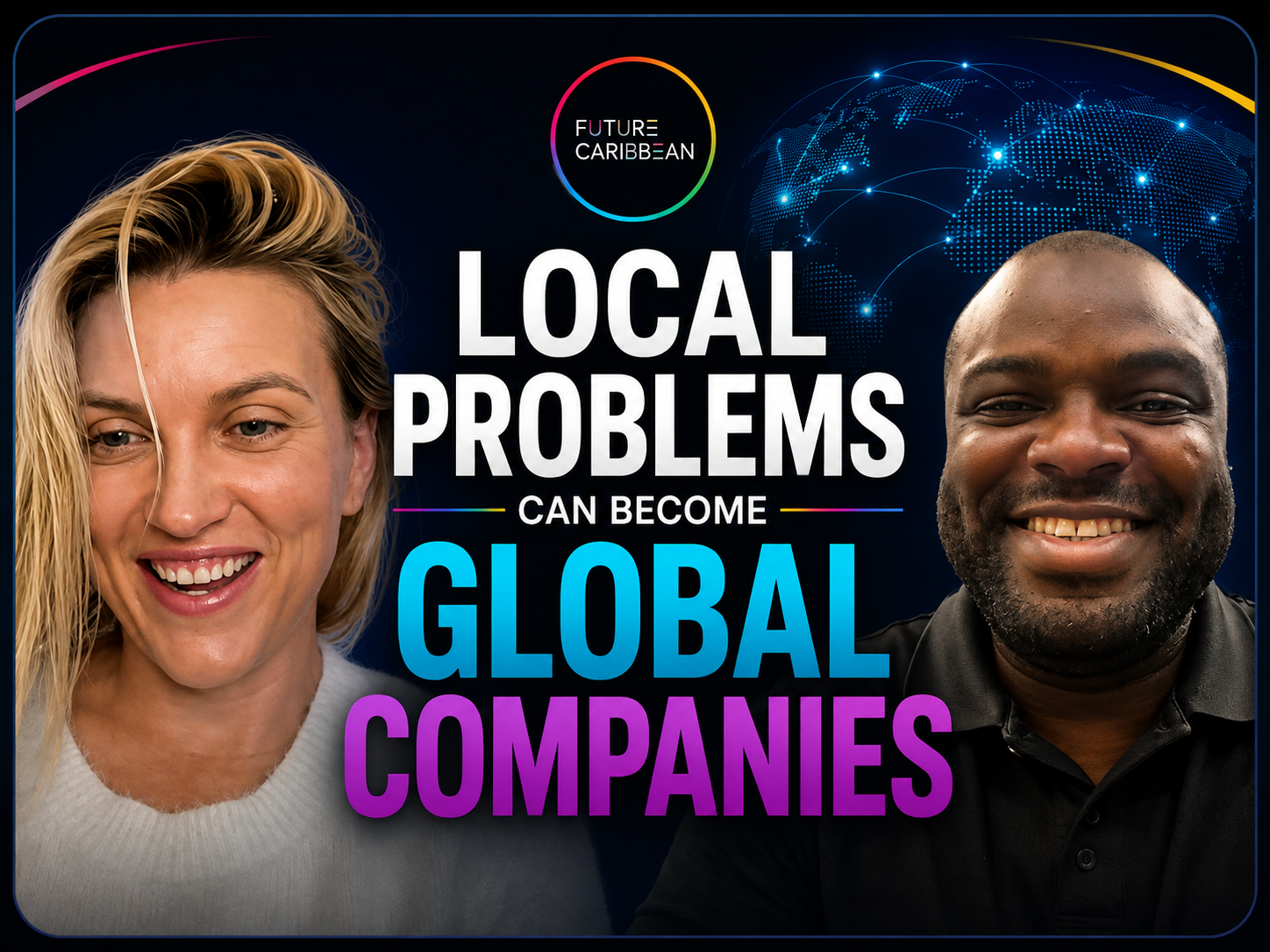
Future Caribbean hosted a fireside chat with Iyinoluwa "E" Aboyeji, founder of Future Africa and co-founder of Andela and Flutterwave, led by Lily Dash. The discussion explored what it takes to build thriving technology ecosystems, develop world-class talent, and use AI to unlock opportunities in emerging markets.
A central message from the conversation was simple: small markets do not have to think small.
Talent Is the Foundation of an Ecosystem
For Aboyeji, ecosystem building starts with people.
He argued that the real work is developing deep talent pipelines — from secondary school to university, from university into employment, and then surrounding that talent with communities where people can continue to grow.
In his view, talent — not governments, investors, or even startups themselves — must sit at the center of a successful ecosystem.
That philosophy is also driving Talent Nation, his effort to build a large-scale pipeline of AI operators, builders, and researchers from Africa.
For emerging markets, this represents a major opportunity: rather than competing solely for capital, countries can build their advantage by developing people who can participate in the global AI economy.
Learn by Building
Another major theme was how rapidly skills now need to evolve.
Aboyeji encouraged builders to move away from thinking of learning and working as separate activities. Instead, the model should be continuous: learn something, build something, learn again, and keep iterating.
AI has expanded what individuals and small teams can create, meaning reputation increasingly comes from demonstrating what you can actually build rather than simply completing coursework.
The same principle applies to companies. Great companies evolve continuously, and the product on day 1 should look very different from the product on day 1,000.
Solve Local Problems That Can Travel Globally
Perhaps the strongest lesson from Aboyeji's experience building Andela and Flutterwave was that local problems can become global companies.
He challenged Caribbean builders not to let the size of their island or market determine the size of their ambition.
Instead, the key question should be:
What problem do you understand better than almost anyone else?
Andela emerged from the challenge of connecting talented young Africans to global work. Flutterwave tackled the difficulty businesses faced receiving payments across borders.
These were local and regional problems, but they were not uniquely African. Similar challenges exist across emerging markets worldwide.
The same could be true for solutions built in the Caribbean — from payments and logistics to climate resilience, healthcare, regulation, or public infrastructure.
AI Changes the Economics of Small Markets
AI is also changing what can economically be built.
Aboyeji argued that technologies which previously would have been too expensive to customize for small markets can now become viable.
That matters enormously for the Caribbean, where imported technologies are often designed for much larger economies and may not reflect local realities.
AI makes it easier to create systems tailored to particular users, jurisdictions, industries, and communities — and to navigate complexity that previously required far greater resources.
He specifically highlighted how AI can make regulatory complexity more manageable and shorten the distance between an idea and its actual implementation.
Small Markets Can Produce Global Impact
The broader message of the fireside chat was that emerging markets should stop treating size as a limitation.
Aboyeji's advice was to focus on problems that matter deeply, build solutions for them, and then look outward.
A challenge experienced in Barbados, Jamaica, Trinidad and Tobago, or another Caribbean market may also exist across Africa, Southeast Asia, Latin America, or dozens of other distributed economies.
The advantage comes from understanding that problem better than outsiders do — and building the solution first.
For the next generation of Caribbean builders, the opportunity is not simply to participate in the global technology ecosystem.
It is to build solutions the rest of the world may eventually need.
Inside Future Caribbean's 12-Hour Demo Day: The Projects Presented
Across ten tracks, Caribbean innovators explored how AI could respond to real challenges — from energy and transportation to finance, climate resilience, healthcare, and the creative economy.
A Glimpse Into Future Caribbean's Demo Weekend
A weekend celebrating Caribbean innovation, AI-powered problem-solving, and the people building solutions for the region's future.