From Reactive to Proactive: Workshop with Longevity Scientist Jessy Abed
Inside Future Caribbean's workshop with longevity scientist Jessy Abed — health span over lifespan, why more data isn't better healthcare, and what agentic AI could unlock for prevention in the Caribbean.

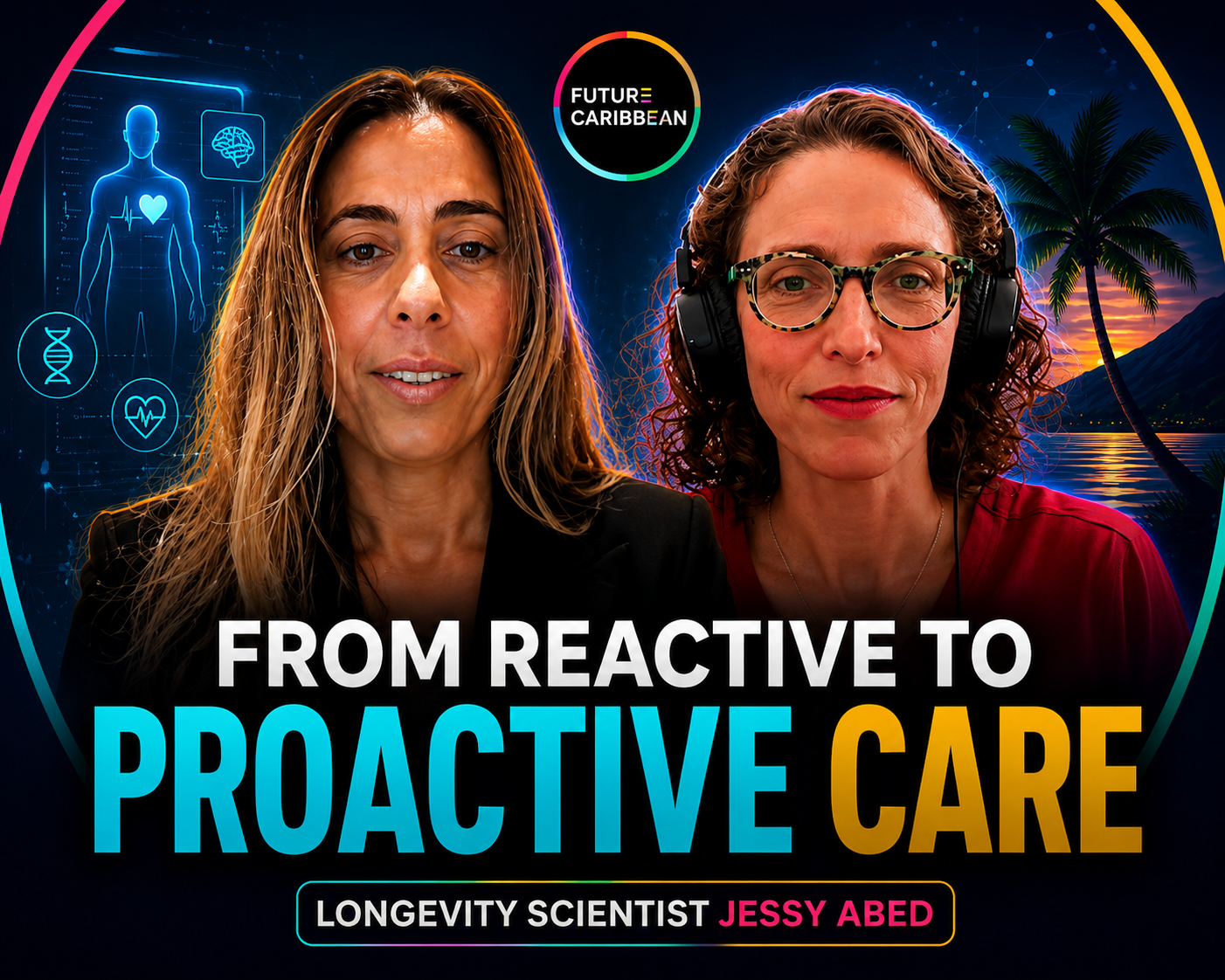
Inside Future Caribbean's workshop with longevity scientist Jessy Abed, exploring how AI could help shift healthcare from treating problems after they appear to understanding, preventing and managing them earlier.
Future Caribbean hosted a workshop with longevity scientist Jessy Abed, moderated by Melissa, to explore one of the most important opportunities emerging at the intersection of healthcare and Agentic AI: moving from reactive care to proactive care.
With 20 attendees, the conversation went beyond the usual discussion of wearables, health dashboards and AI chatbots. Instead, Jessy challenged builders to think about what happens when AI can continuously understand information, reason across it and actually help people take action.
Longevity isn't just about living longer
Jessy began by challenging one of the most common assumptions around longevity.
The goal isn't simply to increase lifespan. It's to increase health span — the number of years a person remains mobile, functional, mentally sharp and able to live well. She pointed out that humanity has dramatically increased lifespan over the last century, while improvements in health span have not kept pace.
That distinction changes how healthcare should be designed.
Instead of waiting for disease to appear and then treating it, the opportunity is to understand the biological signals and risk factors that come earlier — and intervene before they become a larger problem.
For Jessy, this represents a fundamental shift: from treating → to preventing.
The Caribbean has an opportunity to build for prevention
The discussion explored why this shift is particularly relevant to the Caribbean.
Healthcare systems across the region face resource constraints, including limited access to specialized equipment and medical expertise in some islands. Melissa highlighted the reality that patients sometimes have to travel between islands to access specific treatments or specializations.
Rather than attempting to replicate every capability on every island, technology could help the region think differently about how healthcare resources are distributed and accessed.
But Jessy emphasized that the opportunity begins even earlier — before someone becomes a patient.
She discussed non-communicable diseases such as diabetes and the importance of addressing the underlying risk factors rather than waiting until someone requires medical intervention.
Data alone isn't enough
One of the strongest messages for builders was simple:
More data does not automatically mean better healthcare.
Wearables and biomarker technologies can generate enormous amounts of information, but without interpretation, that information can become noise. Jessy argued that AI becomes valuable when it can help transform complex data into something understandable and actionable.
Her own experience in cancer research illustrated the potential. Researchers once had to manually examine spreadsheets of biomarkers, patient characteristics and other variables to identify possible relationships.
AI could accelerate that process — not by replacing the researcher, but by helping them identify patterns and make decisions faster.
Don't build another dashboard
For builders in the room, Jessy had an even more direct challenge.
Healthcare AI shouldn't simply become another dashboard, tracker or chatbot.
The more valuable opportunity is to build systems that can understand, decide, act and learn.
An effective agent could maintain context over time, remember an individual's history, reason across multiple inputs and take appropriate actions based on what it learns.
The distinction is important: the goal isn't for AI to replace doctors or healthcare professionals. It's to extend their ability to support people continuously.
Jessy described the opportunity as turning data → decisions → action.
That is where she sees many current AI solutions falling short.
What could proactive care actually look like?
The conversation moved into a practical example: someone who may be at risk of developing diabetes but isn't yet seriously ill.
Instead of waiting until that person enters the healthcare system with a condition, an AI agent could potentially provide personalized guidance around nutrition, lifestyle and everyday decisions.
Jessy imagined something as simple as a person scanning a QR code while grocery shopping and accessing an AI-powered nutritional coach tailored to their circumstances.
Crucially, that guidance would need to account for the individual's real life.
A personalized system can't assume that everyone has the same income, access to food, time, family responsibilities or lifestyle. Jessy emphasized that solutions need to be designed around the actual socioeconomic circumstances of the people they serve.
That could make preventative healthcare feel less like another medical program and more like continuous, accessible support woven into everyday life.
Building for the individual
Another important shift discussed during the workshop was moving away from thinking only about populations and toward understanding the individual.
Instead of looking at a single medical episode — such as an emergency visit — an agent could potentially maintain a continuous understanding of what is happening with a person's health over time.
That creates a fundamentally different model of care: one where technology helps connect information across time rather than treating every appointment as an isolated event.
At the same time, Jessy stressed that human judgment remains essential. AI should work alongside doctors, nurses and patients rather than simply replacing them.
The real opportunity isn't another longevity product
Jessy's closing challenge to builders was perhaps the most important one.
The opportunity isn't necessarily to create another wearable, another longevity brand or another piece of health technology.
It's to rethink what becomes possible when intelligence can help people navigate the complexity of their own health.
For the Caribbean, that could mean using Agentic AI not just to make existing healthcare processes more efficient, but to help create a more proactive model — one that focuses on prevention, education, personalization and continuous support.
The question for builders is no longer simply: "What health data can we collect?"
It's: "What can we actually do with it?"
And that shift — from information to action, and from reactive treatment to proactive care — may be where the most meaningful healthcare opportunities begin.
Inside Future Caribbean's 12-Hour Demo Day: The Projects Presented
Across ten tracks, Caribbean innovators explored how AI could respond to real challenges — from energy and transportation to finance, climate resilience, healthcare, and the creative economy.
A Glimpse Into Future Caribbean's Demo Weekend
A weekend celebrating Caribbean innovation, AI-powered problem-solving, and the people building solutions for the region's future.