Rashida Denbow's "Make Them Care" Masterclass: Why Great Technology Still Needs a Great Story
Creator and strategist Rashida Denbow on storytelling, pitching and social media for Caribbean founders — the four doorways to attention and the human → practical → technical framework.

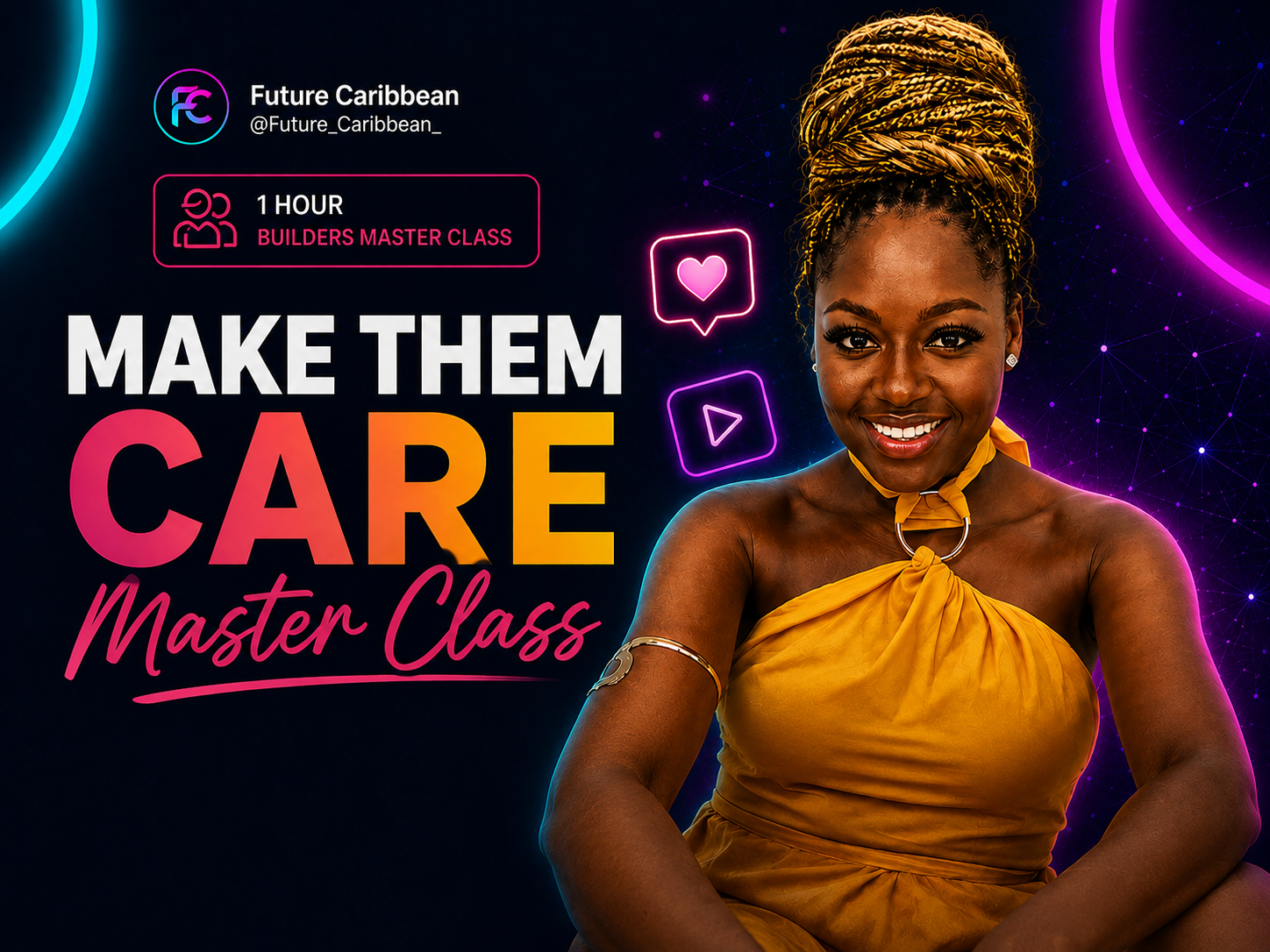
Building an impressive product is only half the challenge for a technology founder. The other half is convincing people that the problem matters, the solution is relevant, and the company is worth their attention.
That was the central message of Future Caribbean's Make Them Care Masterclass, hosted by Lily Dash (@LilyDash) with creator and strategist Rashida Denbow (@onlyrashidaa). The session focused on storytelling, pitching and social media strategy for founders building new technologies across the Caribbean.
For Rashida, the challenge is particularly important because founders often spend months immersed in the technical details of their products. They know the models, architecture, data and features inside out. But a potential user, investor or partner encountering the product for the first time does not share that context — or the founder's emotional investment in it.
As Rashida explained, founders have to accept that an idea can be impressive without automatically being interesting to somebody else. On social media especially, attention must be earned quickly. Instead of assuming audiences will care about a project because of the work that went into building it, founders need to connect their solution to something the audience already cares about: a frustration, ambition, opportunity, identity or possibility.
Start with the audience, not the technology
One of the strongest examples came from Future Caribbean itself.
A conventional description of the initiative could lead with Agentic AI, mentorship, investors, compute and the $50,000 opportunity. All of those details are valuable, but Rashida argued that they are not necessarily the strongest entry point for someone outside the technology ecosystem.
Instead, the campaign opened with a bigger idea: what if the world's next major AI company did not come from Silicon Valley, but from places such as St. Ann, St. Philip or Port of Spain?
Nothing about the underlying opportunity changed. What changed was the doorway into the story. Rather than asking an unfamiliar audience to immediately understand a technical programme, the message invited them to imagine a different future for Caribbean innovation.
Rashida identified four possible doorways founders can use to capture attention:
- Possibility — invite audiences to imagine a different future.
- Opportunity — give them something valuable they can access.
- Tension — introduce a problem, disagreement or unexpected position.
- Participation — ask a question or create space for the audience to contribute.
These approaches are not limited to social media. The same thinking can shape the opening of a pitch, showcase presentation or investor conversation. If one doorway fails to connect, founders can approach the same product through another.
From technical to practical to human
At the heart of the session was Rashida's Make Them Care framework, built around three levels: technical, practical and human.
The technical level explains what the product actually does. The practical level asks what that technology enables or changes. The human level goes further: why should a real person care?
Rashida demonstrated the framework with a fictional company using computer vision to analyse underwater imagery. Technically, the system analyses environmental data. Practically, it can identify changes in coral reefs faster than manual surveys. But the human story is that Caribbean hotels, communities and livelihoods depend on healthy oceans and attractive beaches.
Founders may think about their products from technical → practical → human while developing them. But when communicating them, Rashida advised reversing the order: human → practical → technical.
The audience enters first.
Once people understand why something matters to their own lives, businesses or communities, founders have earned the opportunity to explain how the technology works.
Specificity also matters. "Solving problems in the Caribbean" may sound important, but broad statements can become forgettable. A particular hotel, customer, community, frustration or moment gives an audience something concrete to picture. As Rashida put it during the session, specific stories allow people to feel that the message is speaking directly to them rather than to an anonymous crowd.
Social media is more than a popularity contest
The masterclass also challenged the idea that successful founder content needs hundreds of thousands of views.
Rashida encouraged founders to care more about who sees their content than the raw number of views or likes. A video with only a few thousand views can still be highly successful if it reaches potential customers, investors, collaborators or institutions.
She shared that some of her most valuable professional opportunities have come from people who never publicly liked, followed or commented on her content but later contacted her because they had been watching. Social media, in that sense, is not simply an engagement scoreboard. It is a way to create visibility and signal capability to people founders may never have direct access to otherwise.
It is also a source of data.
Founders should publish, observe what resonates and use the response to improve both their communication and, potentially, their product. If viewers leave a video after eight seconds, that is information. If comments reveal confusion, disagreement or a previously unnoticed problem, that is information too. Rashida encouraged founders to "let the data hurt your feelings" — to treat disappointing performance not as a reason to disappear, but as feedback for the next iteration.
Before creating content, Rashida recommended asking three fundamental questions: Who needs to care? What do they already care about? Which story gives them a reason to enter? The answer may be different for customers, investors, partners, media or the wider public.
For Future Caribbean's builders, the larger message was clear. Creating the technology is an achievement, but building a scalable company requires more. Founders must communicate the problem, demonstrate why they are the people capable of solving it, and make strangers see a future in which their solution matters.
The best technology may deserve attention. Storytelling is how founders earn it.
Inside Future Caribbean's 12-Hour Demo Day: The Projects Presented
Across ten tracks, Caribbean innovators explored how AI could respond to real challenges — from energy and transportation to finance, climate resilience, healthcare, and the creative economy.
A Glimpse Into Future Caribbean's Demo Weekend
A weekend celebrating Caribbean innovation, AI-powered problem-solving, and the people building solutions for the region's future.