MiniMax Onboarding: Equipping Future Caribbean Builders with Powerful Models and Token Plans
Daniel Shi on MiniMax's foundation models, 500 token plans for buildathon teams, routing Cursor or Claude Code to MiniMax endpoints, 512K-1M context windows, and planning before you code.
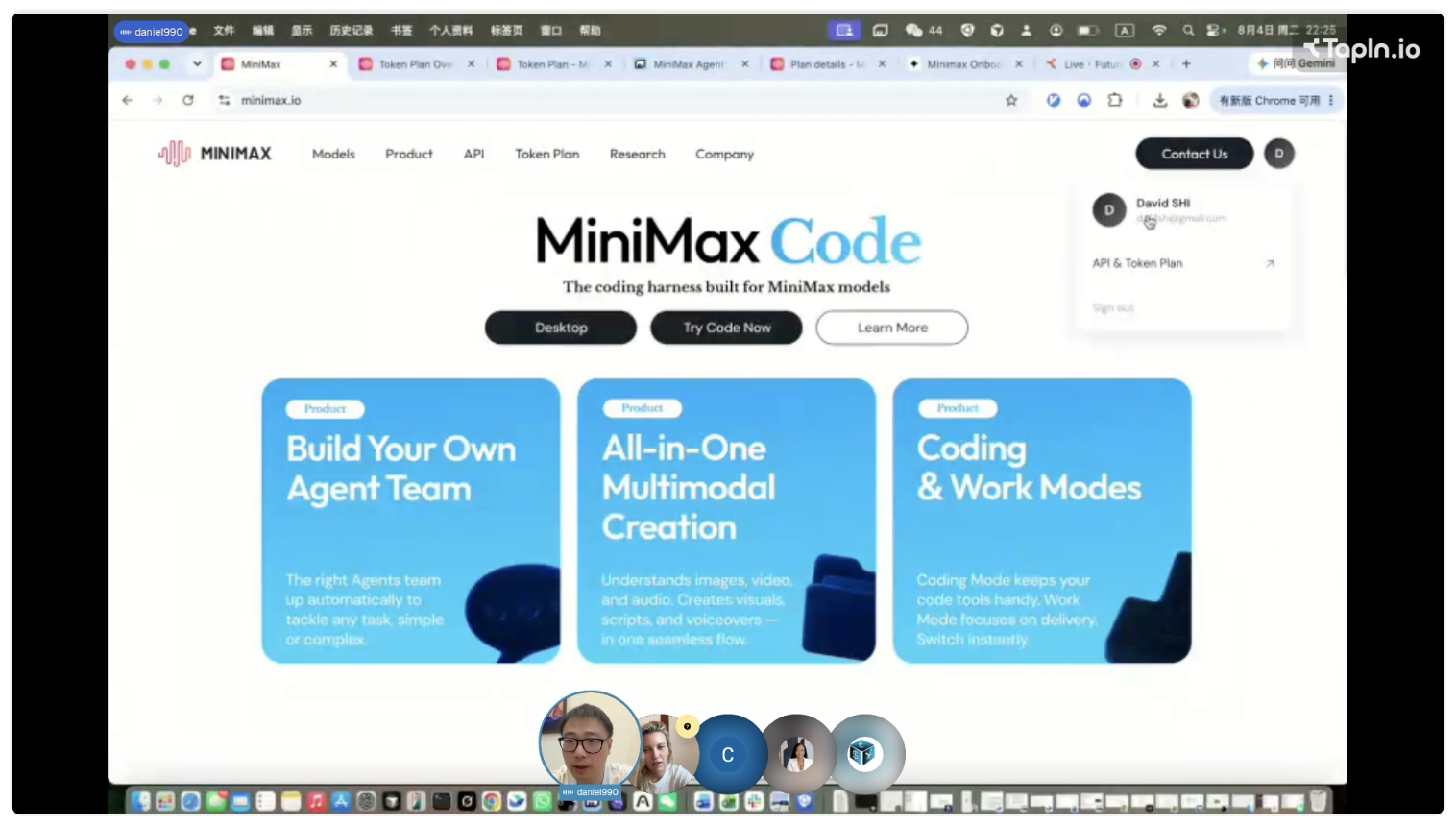
Future Caribbean hosted a live onboarding session with Daniel Shi from MiniMax to introduce builders to the MiniMax platform and help teams understand how to use its models during the Agentic AI Buildathon.
Hosted by Lily Dash, the session covered MiniMax's company background, its large language and multimodal model offerings, how builders can use MiniMax inside familiar coding environments, and practical advice for managing tokens efficiently while developing applications.
A major benefit for the Future Caribbean community is MiniMax's commitment of 500 token plans for buildathon participants, giving builders access to its models for coding and application development.
From AI applications to foundation models
Daniel introduced MiniMax as a company that began operating in 2022 and initially built consumer-facing AI applications, including products focused on AI companionship and video creation.
Through that experience, the team concluded that much of the "magic" behind compelling AI applications came from the underlying models themselves.
That realization led MiniMax to focus more heavily on developing its own foundation models. Daniel described four major model categories currently offered by the company:
- large language models;
- video models;
- voice models;
- music models.
For the Future Caribbean buildathon, the primary focus is on MiniMax's large language model token plans, which builders can use to create and code applications throughout the event.
500 token plans for Future Caribbean builders
MiniMax is supporting the Future Caribbean community with approximately 500 token plans.
Daniel explained that each plan gives builders access to MiniMax models, with a particular emphasis on coding and application development.
Later in the session, he clarified that the codes being provided to Future Caribbean can act as a three-month extension for an existing MiniMax subscription and that the distributed plan is intended to be at the platform's maximum token-plan level.
The access is specifically tied to the Future Caribbean activity and is intended to give participants substantial room to experiment while building.
Why MiniMax is focusing on builders
Daniel made an important point during his introduction: software development has changed dramatically because of large language models.
Tasks that once required significant time and technical effort can now be accelerated with AI-assisted coding.
In his view, this means the main challenge is increasingly not whether an idea is technically possible, but rather what builders choose to create.
That is the thinking behind MiniMax providing token plans to the Future Caribbean community: give builders access to strong models and let them concentrate on turning ideas into working products.
Use MiniMax in familiar coding environments
A major portion of the session focused on showing builders that they do not need to abandon their preferred development tools to use MiniMax.
Daniel explained that builders can use MiniMax's own coding agent, but they can also connect MiniMax to third-party coding environments.
He mentioned tools including Cursor, Claude Code, Codex, Hermes, OpenClaw, VS Code, and other compatible coding agents.
The core requirement is that the development tool support the relevant OpenAI- or Anthropic-compatible endpoint configuration.
This gives builders flexibility to keep working inside the environment they already know while using MiniMax models underneath.
API compatibility and model routing
Daniel demonstrated how developers can route a coding agent to MiniMax by changing the authentication token and base URL.
The process effectively tells the development environment to use MiniMax's endpoint instead of its default model provider.
He emphasized that once the environment is configured correctly, builders can use MiniMax inside familiar tools without completely changing their workflow.
He also pointed out that AI itself can help with configuration. Rather than manually reading every setup instruction, a builder can ask a coding agent to help configure the environment around the MiniMax token plan.
Build with MiniMax's own agent or your preferred tools
Daniel summarized the development options into two broad paths.
Builders can use MiniMax's own coding agent, where access is already tied directly into the MiniMax ecosystem, or they can configure an external coding agent such as Claude Code, Codex, or Cursor to use MiniMax models.
The broader message was flexibility: builders should use the development environment that best fits how they already work.
More than large language models
Although the buildathon allocation focuses primarily on LLM usage, MiniMax offers a wider family of generative AI models.
Lily specifically encouraged Future Caribbean teams to explore MiniMax's video capabilities when creating media and storytelling around their projects.
Her point was that building a strong product is only part of the challenge. Teams also need to communicate what they are building, demonstrate their progress, and help audiences understand why their solution matters.
MiniMax's video tools therefore offer a potential way for teams to complement their technical work with richer demonstrations and project storytelling.
Multimodal capabilities
During the Q&A, builders also asked about MiniMax's multimodal capabilities.
Daniel explained that the M3 model supports visual inputs including images and video, but does not currently understand the audio track contained within a video.
That distinction is useful for teams planning multimodal applications: the model can reason over visual information, but builders should not assume that an uploaded video automatically gives the model access to its spoken audio content.
Plan before you code
One of Daniel's most valuable recommendations came in response to a builder asking how to turn a Figma prototype into an MVP without exhausting all available tokens.
His advice was to avoid beginning with a vague coding prompt. Instead, builders should first use the AI to discuss the product in detail.
Before generating code, teams should clarify:
- what the application is supposed to do;
- its structure;
- the desired features;
- the expected user experience;
- the technical plan.
Daniel warned that vague prompts can cause the model to generate poor-quality work while also wasting significant numbers of tokens.
A better approach is to collaborate with the AI on a detailed plan first and only begin implementation once the structure is clear.
For a time-limited buildathon, this is particularly important. Better planning can help teams conserve both tokens and development time.
Strong mathematical and spreadsheet reasoning
Builders also asked about MiniMax's mathematical reasoning capabilities.
Daniel pointed participants toward public benchmark resources and noted that he personally uses the model extensively for spreadsheet and Excel calculations.
His practical recommendation was simply to test the model against the specific mathematical workload required by the project.
For Future Caribbean teams building financial, analytical, scientific, or operational products, this can be especially relevant.
Large context windows
Another notable technical capability discussed during the Q&A was MiniMax's context window.
Daniel explained that the model supports a standard context window of approximately 512K tokens, which can be expanded to around 1 million tokens. He also noted that the standard context length should already be sufficient for most common use cases.
A large context window can be useful for applications that need to reason across long documents, extensive project files, long conversations, or larger codebases.
Tokens, consumption, and visibility
Daniel also confirmed that builders can monitor token usage and consumption through the MiniMax portal.
This gives teams a way to track how much of their allocation they are using while experimenting and developing their applications.
That visibility becomes especially useful when teams are iterating rapidly and using AI extensively for coding, debugging, reasoning, and application generation.
Build with intention
The MiniMax onboarding session reinforced an important theme running through the Future Caribbean buildathon: access to powerful models matters, but how builders use those models matters just as much.
MiniMax is giving Future Caribbean participants substantial model access through its token plans, along with the ability to work inside familiar coding tools and leverage large context windows, multimodal capabilities, and strong reasoning models.
But Daniel's advice was equally important: plan carefully, give AI clear instructions, and structure the application before asking the model to generate large amounts of code.
For Future Caribbean teams, the combination of 500 token plans, flexible coding integrations, strong foundation models, and multimodal tools gives builders another powerful set of resources for turning ambitious Agentic AI ideas into working products during the buildathon.
Inside Future Caribbean's 12-Hour Demo Day: The Projects Presented
Across ten tracks, Caribbean innovators explored how AI could respond to real challenges — from energy and transportation to finance, climate resilience, healthcare, and the creative economy.
A Glimpse Into Future Caribbean's Demo Weekend
A weekend celebrating Caribbean innovation, AI-powered problem-solving, and the people building solutions for the region's future.