Nebius Onboarding: Fast, Flexible AI Inference for Future Caribbean Builders
Colin Lowenberg walks buildathon teams through Nebius Token Factory: picking models by task, connecting coding agents with Kimi Relay, real-time web search, cloud sandboxes, and $50 in free credits.
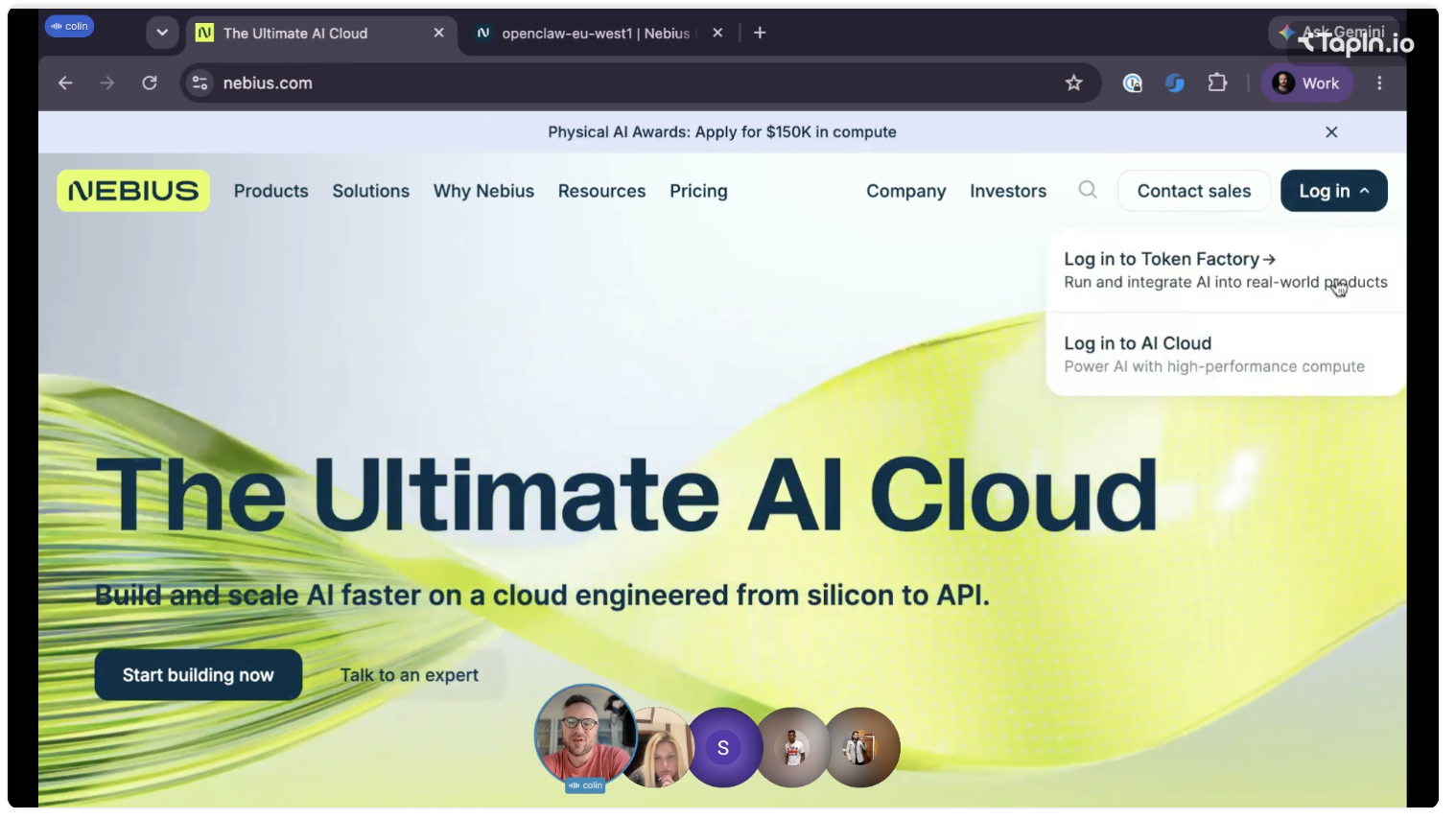
Future Caribbean hosted a live onboarding and Q&A session with Nebius to give Agentic AI Buildathon participants a practical introduction to the Nebius Token Factory, a platform for running leading AI models through fast, cost-efficient inference.
Hosted by Lily Dash, the session featured Colin Lowenberg from Nebius, who walked builders through the platform, model selection, API access, coding-agent integrations, web search, cloud sandboxes, and best practices for building more reliable AI applications.
Future Caribbean teams have also been provided with Nebius credits to help them experiment during the buildathon.
What is Nebius?
Colin introduced Nebius as an AI infrastructure company that operates its own data centers and provides access to Nvidia GPUs for AI workloads.
Nebius offers broader cloud infrastructure for teams that want to rent GPUs, train or run their own models, deploy Kubernetes, use storage, or run Docker workloads. However, the onboarding session focused primarily on a different product: Nebius Token Factory.
Token Factory is designed to make AI inference accessible without requiring teams to rent and manage dedicated GPU infrastructure themselves.
Because Nebius operates the underlying infrastructure directly, Colin explained that the company can focus on delivering inference at high speed and competitive pricing rather than simply reselling another provider's compute.
Nebius Token Factory
Token Factory gives developers access to hosted large language models through API endpoints.
Builders can choose from different models depending on the requirements of their application, including the balance between performance, latency, and cost.
During the session, Colin discussed models including Kimi K3, MiniMax M3, GLM, and Nvidia's Nemotron, highlighting that the most powerful model is not necessarily the right model for every task.
For example, a less expensive model may be perfectly suitable for high-volume or simpler workloads, while a stronger reasoning or coding model may make more sense for complex development tasks.
That ability to switch models gives builders greater control over the economics of their applications.
Choose models based on the task
One of the most useful lessons from the onboarding was Colin's emphasis on model selection.
He compared Kimi and MiniMax during the session to demonstrate how differently priced models can still perform well on the same task.
His broader recommendation was that builders should avoid assuming that the highest-end model is always required. Instead, teams can test models in the Token Factory playground and choose the model that offers the right combination of quality and cost for their use case.
For buildathon teams, this can make it possible to design AI applications that remain economical even when they generate large numbers of model calls.
Dedicated endpoints and data controls
Nebius also provides options for teams that require greater control over where and how their inference runs.
Colin explained that developers can create dedicated endpoints, including choosing infrastructure locations that may better fit geographic, privacy, or compliance requirements.
He also highlighted a Zero Data Retention option within Nebius settings for use cases where retaining API request data would be inappropriate.
These options can be especially relevant for applications involving sensitive enterprise, healthcare, legal, or regional data requirements.
Using Nebius with existing AI development tools
The session focused heavily on making Nebius practical for developers who already use popular coding agents.
Rather than forcing builders to abandon their preferred tools, Token Factory can be connected to existing development workflows.
Colin discussed integrations with environments and agents including:
- Claude Code
- Codex
- Cursor
- OpenCode
- Pi
- Goose
- Kimi Code
This means builders can continue working in familiar development interfaces while routing model inference through Nebius.
Kimi Relay
To simplify this process, Colin demonstrated Kimi Relay, a tool he built to connect command-line coding agents to Kimi models running through Nebius Token Factory.
Kimi Relay allows developers to launch supported coding agents using Nebius without permanently changing the agent's normal configuration.
For example, builders can run an agent through Kimi Relay in one terminal while preserving their normal setup in another.
The tool is particularly useful for terminal-based development workflows and allows builders to experiment with Nebius-hosted models without rebuilding their existing setup.
Teaching coding agents new skills
Colin also demonstrated a GitHub-based Token Factory skill designed to teach coding agents how to configure and use Nebius.
The skill can help an agent understand details such as the Nebius API key, base URL, Token Factory console, credits, and available documentation.
This led to one of Colin's broader development recommendations: rather than manually learning every new platform from scratch, developers can increasingly create reusable skills that teach their AI coding agents how to work with new services.
In his example, the agent could learn the Token Factory setup and help configure the development environment itself.
Experiment in the Token Factory playground
Builders who are not working primarily through the command line can still experiment with Nebius directly through the Token Factory playground.
The playground allows users to test prompts against different available models before incorporating them into an application.
This is particularly useful for comparing output quality, testing model behavior, and deciding whether a more expensive model is actually necessary for a particular task.
Bringing real-time web search to AI agents
Another major part of the session focused on giving AI agents access to current information.
Colin demonstrated toLily, a web-search service that can be connected to Kimi Relay and other agentic workflows.
By adding web search, an AI agent can look beyond the information contained in its original model training and retrieve current information from the internet.
During the live demo, Colin used toLily to perform research, gather sources from the web, and generate a detailed response based on those findings.
For builders creating research assistants, travel applications, market-intelligence tools, news-aware agents, or other products that depend on current information, this kind of capability can significantly expand what an AI application can do.
Live vibe-coding with Kimi K3
The second half of the onboarding moved into a live coding demonstration.
Colin launched a coding agent using Kimi K3 through Nebius Token Factory and asked it to build a venue directory for hackathon events.
The concept was to create a directory of coffee shops, coworking spaces, and other potential event venues across cities around the world, including Caribbean locations.
The agent began researching existing venue information, gathering data, and generating the application while the onboarding session continued.
Colin also showed Compute Cafe, a project he had previously built using a similar workflow. Its stack included Claude Code, Kimi Relay, Kimi K3, Nebius Token Factory, toLily, and a cloud sandbox environment.
The demonstration illustrated how multiple AI development tools can be combined into a larger agentic workflow rather than relying on a single model or platform.
Use different models for building and reviewing
One of Colin's strongest development recommendations concerned adversarial quality assurance.
Instead of asking the same model to write code and then review its own work, he suggested using a different model or agent for code review.
For example, a team might generate an application using Kimi and then have Claude independently review the resulting code.
The reasoning is straightforward: a model may reproduce or overlook the same kinds of mistakes when reviewing code it effectively generated itself, while a separate model can bring a different perspective to the review.
For teams building quickly during a buildathon, this can be a useful way to improve reliability without slowing development significantly.
Run AI-generated code in a sandbox
Colin also recommended that builders avoid automatically executing AI-generated code directly on their own machines.
Instead, generated code can be run inside an isolated Docker container, sandbox, or cloud virtual machine.
The session introduced TenKey, which provides cloud sandboxes and code-review tools designed for agentic development.
Its sandboxes can run generated code in isolated environments, while its code-review product can execute and test code as part of the review process.
This approach gives developers an additional safety boundary when working with autonomous coding agents.
Credits for Future Caribbean builders
Nebius is supporting Future Caribbean builders with free credits for Token Factory.
During the onboarding session, Colin directed builders to nebius.builders, where eligible participants could request $50 in Token Factory credits.
He also noted that promotional access was specifically intended to help participants experiment with Token Factory throughout the buildathon.
Additional credits for services demonstrated during the call, including toLily and TenKey, were also discussed during the session.
One important distinction came up during the Q&A: the promotional Token Factory credits do not automatically apply to Nebius Cloud GPU infrastructure. Colin explained that the free credits being discussed were for Token Factory rather than the broader Nebius Cloud service.
Building smarter agentic applications
The Nebius onboarding session gave Future Caribbean teams a practical look at how modern AI applications can be assembled from multiple specialized components.
Rather than relying on one model for every task, builders can choose different models according to cost and performance, connect those models to familiar coding agents, give their applications real-time web access, execute generated code inside isolated sandboxes, and use separate models for independent code review.
The broader message from the session was that effective agentic development is increasingly about orchestration.
Nebius Token Factory provides the inference layer, but builders can combine it with coding agents, search tools, skills, sandboxes, and review systems to create applications that are more capable, more economical, and easier to experiment with.
For Future Caribbean participants, those capabilities — along with the credits provided by Nebius — offer plenty of room to test ambitious ideas throughout the buildathon.
Inside Future Caribbean's 12-Hour Demo Day: The Projects Presented
Across ten tracks, Caribbean innovators explored how AI could respond to real challenges — from energy and transportation to finance, climate resilience, healthcare, and the creative economy.
A Glimpse Into Future Caribbean's Demo Weekend
A weekend celebrating Caribbean innovation, AI-powered problem-solving, and the people building solutions for the region's future.